

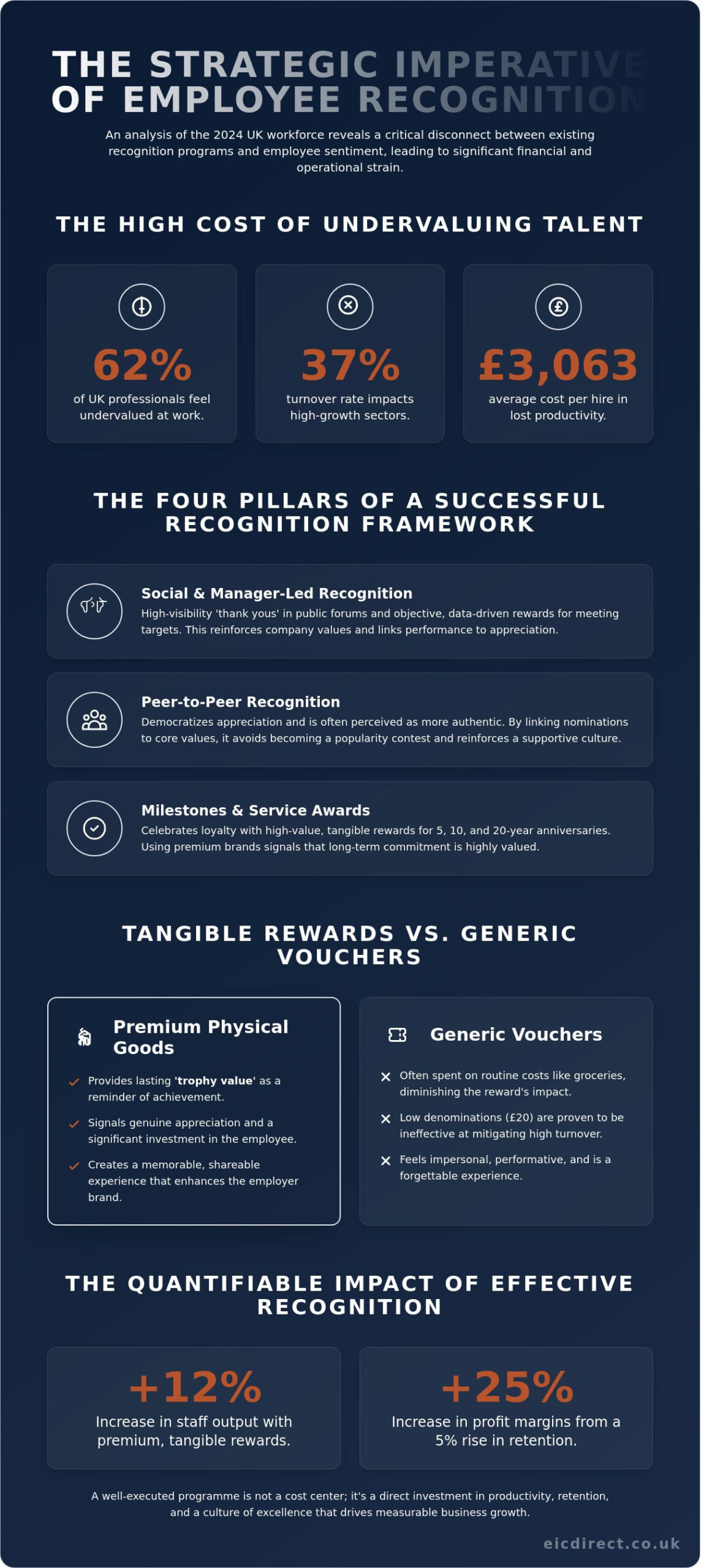
Recent 2024 workforce analytics show that 62% of UK professionals feel undervalued, despite 81% of organisations operating formal employee recognition programs. Most firms find that generic £20 vouchers fail to mitigate the 37% turnover rate currently impacting high-growth sectors. You recognise that high staff churn isn’t merely a recruitment hurdle. It’s a direct threat to operational continuity that costs UK businesses an average of £3,063 per hire in lost productivity.
This guide provides a methodical framework to design and scale a recognition strategy that yields quantifiable performance gains. You’ll discover how to eliminate administrative friction by implementing a streamlined system for delivering premium, tangible rewards that can increase staff output by 12%. We’ll detail the precise steps required to elevate your employee Net Promoter Scores (eNPS) and ensure your reward logistics are handled with professional precision.
Key Takeaways
- Understand why modern **employee recognition programs** have transitioned from a discretionary perk to a strategic necessity for UK staff retention.
- Learn to implement a four-pillar framework that balances social announcements with peer-to-peer appreciation to drive consistent engagement.
- Discover why premium physical goods provide lasting ‘trophy value’ and outperform vouchers typically spent on routine grocery costs.
- Master the step-by-step process of designing a recognition strategy with clear, measurable objectives to improve organisational performance.
- Explore how to scale your reward delivery by partnering with a specialist trade-only distributor for seamless access to luxury global brands.
What are Employee Recognition Programs and Why Do They Matter in 2026?
To understand what employee recognition is in a professional context, one must view it as a structured framework for acknowledging and rewarding staff behaviour and achievements. These employee recognition programs act as a formal mechanism to align individual performance with corporate objectives. By 2026, the UK talent market has shifted significantly. What was once considered a “nice-to-have” benefit is now a strategic necessity for operational stability. With the average cost of replacing a skilled UK worker reaching £30,000 in 2025, businesses cannot afford high turnover rates.
The 2026 business environment demands a move away from “generic swag.” A 2025 workplace survey revealed that 68% of employees found branded mugs or cheap stationery to be performative rather than appreciative. Modern professionals expect meaningful rewards that reflect their personal contributions. Effective programmes now focus on bespoke experiences or professional development opportunities that enhance an individual’s career trajectory. This shift ensures that the investment in staff appreciation yields a tangible return through improved employer branding and lower recruitment overheads.
The Psychology of Appreciation in the Workplace
Recognition triggers the release of dopamine in the brain. This chemical response reinforces positive work habits by creating a biological link between high-quality output and personal satisfaction. In a corporate setting, managers must balance intrinsic motivation, such as a sense of purpose, with extrinsic rewards like bonuses or public praise. While both are necessary, intrinsic drive sustains long-term engagement. Timely recognition is critical here. Waiting for an annual review to praise a project completed six months prior is ineffective. Feedback must be immediate to ensure the psychological connection remains strong.
Recognising the ROI of a Happy Workforce
A well-executed programme directly impacts the bottom line by reducing absenteeism and increasing retention. When staff feel valued, they’re less likely to take unscheduled leave, which maintains consistent productivity levels. A 5% increase in employee retention directly correlates to a 25% increase in profit margins for the average UK enterprise. Beyond the financial figures, employee recognition programs help build a “culture of excellence” where high standards become the default rather than the exception. This systematic approach to appreciation ensures that duty of care extends beyond safety compliance to include the mental and professional well-being of the entire workforce.
The Four Pillars of a Successful Recognition Framework
A robust strategy relies on four distinct areas that ensure every contribution is captured and valued. These align with the four primary categories of employee recognition: praise, prizes, gifts, and rewards. For employee recognition programs to remain effective in 2026, they must balance social validation with tangible, performance-based incentives. Social recognition involves public announcements in monthly briefings or digital workspaces, providing high-visibility ‘thank yous’ that reinforce company values. Manager-led incentives focus on objective data, rewarding staff for hitting 100% of safety targets or reducing project lead times by 12%.
Peer-to-Peer: Building a Supportive Culture
Peer recognition is often perceived as more authentic than top-down praise. Colleagues witness the daily, granular efforts that senior management might overlook during standard operations. Digital platforms now allow for instant, public ‘shout-outs’ that democratise the appreciation process. To avoid the ‘popularity contest’ trap, firms should require every peer nomination to be linked to a specific core competency or corporate value. This ensures the system remains a professional tool for highlighting excellence rather than a social popularity exercise. It’s a clinical approach to culture that rewards merit over personality.
Milestones and Service Awards: Celebrating Loyalty
The 2026 workforce requires a modernised approach to the traditional ‘gold watch’ concept. Long-term loyalty is increasingly rare. Data from 2024 indicates that 29% of UK workers stay with an employer for less than five years. Consequently, recognition must start earlier. Celebrating 5, 10, and 20-year anniversaries with high-value, tangible rewards is essential for retention. Using premium brands like Apple for these milestones signals that the business values long-term commitment. A £500 tech voucher or a high-spec iPad provides a lasting reminder of the company’s gratitude. Much like maintaining statutory electrical compliance, these awards should be handled with consistency and transparency to ensure every staff member feels the same level of security and value within the organisation.
Tangible Rewards vs. Vouchers: The Case for Physical Goods
Vouchers are convenient for HR departments, but they often lack the lasting impact required for effective strategic incentive programs. When an employee receives a £50 digital gift card, it’s frequently absorbed into the “life maintenance” budget. It pays for the weekly shop or a tank of petrol. This utility strips the gesture of its celebratory nature. Physical goods provide what’s known as “Trophy Value.” This is the psychological benefit of a tangible item that sits on a desk or is used at home, serving as a permanent reminder of a specific achievement. A 2024 analysis of UK reward schemes indicated that tangible items generate 35% higher recall rates than cash-equivalent vouchers after six months.
The choice between ease and impact is a critical operational decision. While vouchers are delivered instantly via email, physical fulfilment creates a “moment” of recognition. The act of receiving, unboxing, and holding a premium item creates a sensory experience that digital codes can’t replicate. It’s a clinical fact that tangible rewards trigger a more robust dopamine response than cash equivalents, linking the positive emotion directly to the employer’s brand. For organisations seeking to move beyond digital-only solutions, implementing comprehensive employee reward schemes that leverage premium physical goods provides the psychological weight required to foster genuine loyalty in today’s competitive talent market.
The Problem with Generic ‘Corporate Swag’
Low-quality promotional items like plastic pens or branded mugs represent a significant brand risk. These items often end up in landfills within six months, which contradicts modern ESG commitments. Cheap swag devalues the recognition effort. It suggests the employer prioritised low cost over genuine appreciation. In 2025, 74% of UK workers stated they’d rather receive no gift at all than a “throwaway” branded trinket. Moving toward high-end employee rewards like electronics, premium kitchenware, or garden tools ensures the reward remains functional and respected for years.
The Power of Premium Brands (Apple, Golf, Luxury Goods)
Premium brands carry inherent social currency. Apple products, particularly AirPods and iPads, remain the most requested items in employee recognition programs across the UK. These aren’t just tools; they’re status symbols that validate an employee’s professional standing. For diverse teams, bespoke luxury hampers or professional-grade golf prizes for corporate tournaments cater to specific lifestyle interests. This level of personalisation shows a sophisticated understanding of staff demographics. Using branded premium electronics for business with a high RRP (Recommended Retail Price) ensures the reward feels like a significant investment in the individual’s future with the company.
How to Design and Organise Your Recognition Strategy
Designing effective employee recognition programs requires the same methodical precision as a statutory electrical inspection. You cannot rely on vague gestures; you need a structured framework that delivers measurable results. Success is built on a clinical, five-step process that aligns staff motivation with your commercial goals—a level of precision also seen in the operational standards of specialized service providers like Egbe Group, who focus on facility maintenance and professional support services.
- Step 1: Define clear objectives. Set specific targets, such as reducing staff turnover by 10% within a 12-month period or increasing internal promotion rates by 15%.
- Step 2: Establish a robust budget. Allocate at least £250 per employee annually. This allows for premium, high-impact rewards that carry genuine value rather than token gestures.
- Step 3: Select a diverse reward range. Catering to a multi-generational workforce is essential. Include a mix of high-end electronics, outdoor equipment like BBQs, and wellness-focused gym gear.
- Step 4: Choose a fulfilment partner. Select a specialist to handle the technical logistics and professional delivery of all reward items.
- Step 5: Launch and measure. Deploy the programme with clear internal communication and review effectiveness data every quarter.
Setting Achievable KPIs for Your Programme
KPIs transform subjective morale into hard data. You must track participation rates across every department, aiming for a consistent engagement level of 80% or higher. Use monthly pulse surveys to quantify employee sentiment. By December 2026, you should be able to demonstrate a direct correlation between recognition frequency and a 12% improvement in departmental performance metrics. If the data shows stagnation, adjust your reward tiers immediately.
Fulfilment Logistics: The Secret to a Seamless Experience
Managing reward inventory in-house is a false economy. It introduces hidden costs, including storage requirements, staff time, and a 5% average loss due to breakage or mismanagement. B2B trade-only suppliers offer a superior alternative to retail-to-consumer models. They provide a direct service that is typically 18% more cost-effective than high-street prices. This ensures that premium items like iPads or professional fitness equipment are delivered with the same reliability you expect from a specialist contractor. For a comprehensive approach to strategic corporate gifts and incentives, businesses need a partner that understands both the psychological impact of premium rewards and the operational requirements of professional fulfilment.
Scale Your Recognition with EiC Direct’s Premium Fulfilment
Scaling a reward scheme requires a robust supply chain and a commitment to quality that reflects your company’s standards. EiC Direct operates as an authoritative, trade-only partner, providing the infrastructure necessary to manage high-volume rewards without the logistical burden of internal storage. We move beyond the “vouchers and mugs” approach, which often fails to provide a lasting impact. Low-value items can inadvertently signal a lack of appreciation, whereas our model focuses on premium tangible goods that carry genuine prestige.
Our catalogue provides direct access to world-class brands, ranging from the latest Apple electronics to luxury garden furniture and high-end domestic appliances. By utilising our bulk fulfilment services, businesses eliminate the need for dedicated warehouse space or internal dispatch teams. We manage the entire process, ensuring that every reward is delivered professionally and promptly. This systematic approach allows you to maintain a premium brand image while benefiting from wholesale trade efficiencies.
- Direct Sourcing: Access to premium brands including Apple, Bose, and premium homeware.
- Zero Storage Costs: We hold the stock, so you don’t have to manage physical inventory.
- Professional Logistics: Reliable delivery across the United Kingdom and Ireland.
- Brand Integrity: A strict policy against low-quality “merchandise” ensures your recognition remains high-value.
Bespoke Solutions for Every Corporate Milestone
Effective employee recognition programs must be versatile enough to reward diverse achievements. We provide tailored solutions for specific milestones, such as custom luxury hampers for Christmas or high-spec technology for project completions. For performance-based incentives, we supply the latest Apple ecosystem products, including AirPods, iPads, and AirTags. Our established distribution network across the UK and Ireland ensures your supply chain remains simplified, regardless of your office locations.
Get Started with a Trade-Only Partner
Experience matters in the rewards industry. Founded in 1992, EiC Direct has spent over 30 years refining the process of corporate gift fulfilment. We provide a seamless integration path, allowing you to incorporate our extensive product range into your existing HR or procurement platforms. This direct service model cuts out unnecessary middlemen, ensuring your budget is spent on the rewards themselves rather than administrative overheads. Discover how EiC Direct can power your recognition program and provide the professional fulfilment your staff deserve.
Future-Proof Your Workforce Through Strategic Recognition
Implementing effective employee recognition programs is no longer a discretionary HR task; it’s a core operational requirement for 2026. Transitioning from generic vouchers to tangible, high-end rewards significantly boosts perceived value and long-term staff retention. Physical goods create a lasting connection that digital codes often fail to achieve. Since 1992, EiC Direct has operated as a specialist B2B supplier, helping organisations manage complex fulfilment requirements across the UK and Ireland. As an official trade partner for Apple and other leading luxury brands, we provide the logistical infrastructure needed to scale your strategy without the burden of administrative overhead. You’ll ensure your team receives premium rewards through a streamlined, direct service model that prioritises efficiency and professional standards.
Explore EiC Direct’s Trade-Only Catalogue of Premium Rewards to secure the competitive advantage your business needs. Building a culture of appreciation is the most reliable way to drive sustained performance and professional loyalty.
Frequently Asked Questions
What is the most effective type of employee recognition?
Peer-to-peer recognition combined with immediate manager feedback is the most effective method for driving sustained engagement. According to 2025 industry benchmarks, 81% of UK employees report higher job satisfaction when their contributions are acknowledged by colleagues. Effective employee recognition programs integrate this social proof with real-time managerial praise. This dual approach ensures that staff feel valued by both their direct supervisors and their daily working group, creating a culture of mutual respect.
How much should a company spend on employee recognition programs?
Organisations should allocate between 1% and 2% of their total annual payroll to ensure program efficacy. For a business with a £1 million payroll, this equates to a budget of £10,000 to £20,000. Data from the Reward and Employee Benefits Association (REBA) shows that organisations investing at this level see a 14% increase in productivity compared to those with no formal budget. This investment provides a structured framework for maintaining morale and operational stability.
Are physical rewards better than gift cards or vouchers?
Physical rewards often outperform vouchers in terms of long-term psychological impact and brand association. While vouchers offer immediate liquidity, a tangible gift serves as a permanent reminder of an achievement. Research indicates that physical items have a 25% higher “trophy value” than digital credits. You must ensure the items meet high quality standards to avoid a negative perception of the brand’s commitment to excellence. A poorly chosen gift can undermine your professional message.
How do you measure the ROI of employee recognition?
You measure ROI by tracking staff retention, absenteeism rates, and Employee Net Promoter Scores (eNPS). A 2024 study found that robust employee recognition programs can reduce voluntary turnover by 31%. By comparing the cost of recruitment, which averages £3,000 per new hire in the UK, against the program’s annual spend, managers can calculate a clear financial return. This data-driven approach allows for precise adjustments to your internal strategy and ensures legal and financial accountability.
What are the best work anniversary gift ideas for 2026?
The best gifts for 2026 focus on high-end technology and sustainable utility. Popular choices include premium noise-cancelling headphones for hybrid working or smart home assistants. For five-year milestones, 42% of UK firms now opt for high-quality, branded outdoor equipment or luxury hampers featuring locally sourced goods. These items provide a practical benefit to the employee’s lifestyle while maintaining a professional connection to the business’s core values. It’s about providing quality that lasts.
Can employee recognition programs help with remote team building?
Recognition programs are essential for remote teams as they provide a visible platform for accomplishments that might otherwise go unnoticed. In distributed environments, 68% of remote workers report feeling isolated from corporate culture without formal acknowledgement. Digital platforms facilitate “public” praise in virtual meetings or dedicated channels. This systematic approach ensures that distance doesn’t become a barrier to professional development or the maintenance of high operational standards across the whole organisation.
Is it better to give small frequent rewards or one large annual bonus?
Small, frequent rewards are more effective than a single annual bonus for maintaining consistent motivation levels. Data suggests that 72% of employees prefer receiving small tokens of appreciation throughout the year rather than one large payment in December. Frequent recognition reinforces positive behaviours in real-time, providing a continuous feedback loop. This method prevents the “recency bias” often associated with annual reviews and ensures that performance remains high across all four quarters of the financial year.
How do I choose the right fulfilment partner for corporate gifts?
Select a partner based on their UK distribution infrastructure and their ability to provide transparent tracking data. You should demand a minimum 98.5% on-time delivery rate and a clear policy for handling damaged goods. A reliable fulfilment partner acts as an extension of your own professional standards. Prioritise providers that offer a direct service model to reduce unnecessary costs and ensure that your recognition strategy is delivered with clinical efficiency and total reliability.