

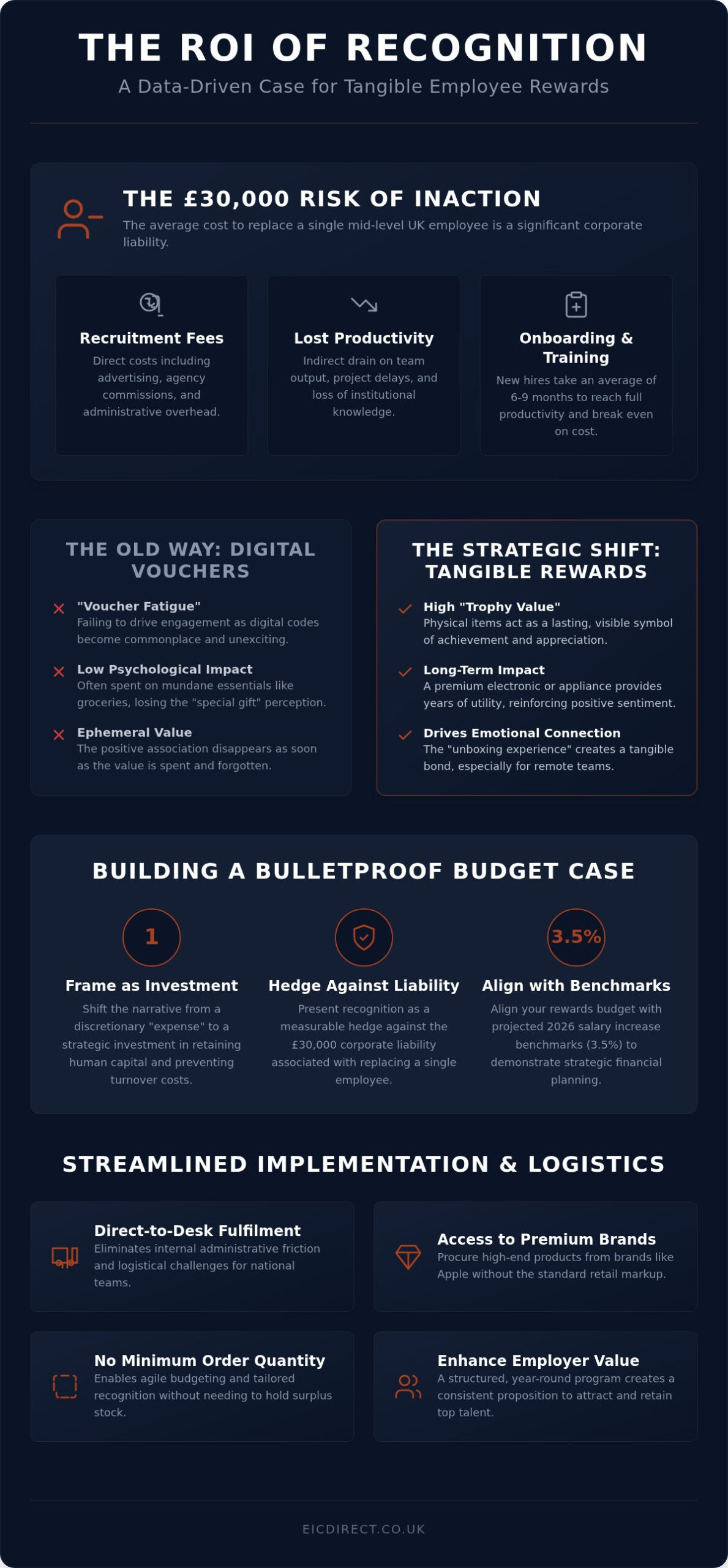
Replacing a single mid-level employee in 2026 costs your business upwards of £30,000 in recruitment fees and lost productivity. Despite this financial risk, the process of justifying an employee rewards budget often meets resistance from stakeholders who view appreciation as a discretionary expense. You likely recognize that generic digital vouchers are failing to drive engagement, leading to “voucher fatigue” and a perceived lack of value during budget reviews. It’s difficult to secure buy-in when you can’t clearly demonstrate the return on investment for every pound spent.
This guide provides the data-driven framework required for transforming your recognition strategy into a measurable driver of retention and ROI. You’ll learn how to move beyond ephemeral incentives to secure long-term stakeholder buy-in. We will examine why tangible premium assets, such as high-end electronics or bespoke hampers, offer superior “trophy value” compared to taxable cash bonuses. By the end of this article, you’ll have a structured business case that aligns your rewards strategy with corporate liability management and the 3.5% salary increase benchmarks projected for 2026.
Key Takeaways
- Define rewards as a strategic hedge against the £30,000 average cost of UK staff replacement rather than a discretionary expense.
- Leverage the high trophy value of physical assets like Apple electronics or luxury hampers to drive higher engagement than taxable cash or digital vouchers.
- Use a data-driven framework for justifying an employee rewards budget that presents recognition as a measurable driver of ROI to your stakeholders.
- Streamline national logistics through a professional direct-to-desk fulfillment model that eliminates the administrative friction of internal distribution.
The Business Case for a Dedicated Employee Rewards Budget
Justifying an employee rewards budget requires a fundamental shift from viewing recognition as a discretionary expense to seeing it as a strategic investment in human capital. In 2026, the principles of Reward Management suggest that a structured approach to appreciation is a primary driver of retention. Without a dedicated budget, recognition becomes inconsistent, reactive, and ultimately ineffective at maintaining morale. A proactive strategy ensures that rewards are not just occasional perks but are integrated into the operational fabric of the business.
The efficacy of digital-only schemes is declining as “Voucher Fatigue” sets in across the UK workforce. When rewards are reduced to a simple digital code, they often lose their psychological impact and are frequently spent on mundane essentials rather than being perceived as a special gift. High-impact employee reward schemes now prioritise tangible assets that align with corporate brand values. Physical items, such as Apple AirPods or bespoke luxury hampers, create a lasting positive association with the employer that digital points cannot replicate.
The Financial Reality of Employee Turnover
The cost of replacing a mid-level professional in the UK now averages £30,000 when accounting for recruitment fees, onboarding, and lost productivity. Direct costs like advertising and agency commissions are only the surface; the indirect drain on team output and institutional knowledge represents a significant corporate liability. The break-even point for a new hire occurs when their cumulative value exceeds the total cost of their recruitment and training, a process that typically takes six to nine months. Investing in premium incentives serves as a preventative measure for “quiet quitting,” ensuring that high-performers remain engaged and productive within the organisation.
Moving Beyond the “Perk” Mentality
To succeed in justifying an employee rewards budget, leadership must move away from the “nice-to-have” mentality and treat recognition as essential infrastructure. A structured, year-round budget allows for a consistent Employer Value Proposition (EVP) that attracts and retains top-tier talent. Relying on ad-hoc spending often leads to unequal distribution and administrative friction. By establishing a clear financial framework, businesses can move from reactive gifting to a systematic model that rewards specific milestones and behaviours with clinical efficiency.
Calculating ROI: Tangible Rewards vs. Digital Vouchers
When justifying an employee rewards budget, the focus often shifts to the method of delivery. While digital vouchers are easy to distribute, they frequently lack the psychological impact required to drive long-term retention. Data indicates that vouchers are often absorbed into monthly household spending for mundane essentials like groceries or utility bills. In contrast, physical items carry significant “Trophy Value”—whether it is a high-end gadget or a bespoke automotive upgrade sourced via iconwheels.com. These items remain visible and functional, serving as a persistent reminder of corporate appreciation long after the initial award.
The unboxing experience is particularly vital for remote and hybrid teams. Receiving a physical package creates a tangible connection to the office that a digital code simply cannot achieve. This shift towards quality is a cornerstone of high-end employee rewards, where the focus is on prestige and utility. By providing items that employees actually desire but might not purchase for themselves, businesses create a deeper emotional bond with their workforce.
The Longevity of Physical Incentives
A cash bonus has a short “half-life” because its impact disappears once the funds are spent. High-quality home appliances or premium electronics provide years of service. Every time an employee uses a gifted coffee machine or tablet, they are reminded of their professional achievement. This also generates social proof; physical rewards are often discussed with peers and family, amplifying the positive impact of employee recognition strategies beyond a single transaction.
Procurement Efficiency and Bulk Fulfilment
Efficiently justifying an employee rewards budget also requires looking at the procurement chain. Partnering with a specialist trade-only supplier allows businesses to access premium brands without the retail markup. Models that offer No Minimum Order Quantity (MOQ) are essential for agile budgeting, allowing for tailored recognition without the need for surplus stock. This streamlined approach reduces the administrative burden on HR departments, consolidating logistics through a single professional partner like EiC Direct. Trade-only access ensures that the budget is spent on high-perceived-value goods rather than platform fees or middleman commissions.
Justifying the budget often involves showing how it supports operational excellence; to further support your team’s professional growth in key operational areas, visit CMI Communications & Management Institute for industry-recognised training in procurement and supply chain management.
Structuring Your Budget for Maximum Stakeholder Buy-In
A structured financial framework is essential for justifying an employee rewards budget to a board of directors. Instead of treating recognition as a single line item, successful organisations categorise spend into distinct streams: milestone awards for long-service, performance-based incentives for hitting KPIs, and seasonal gifting. This granularity allows finance teams to track the ROI of employee appreciation with greater precision. It transforms a vague “perk” into a quantifiable retention tool.
Quality must supersede quantity to maintain the integrity of the scheme. Distributing low-value branded items like mugs or keyrings often devalues the act of recognition and contributes to corporate waste. By selecting durable, premium products, companies align their rewards strategy with ESG and sustainability goals. Utilising professional prize fulfilment services ensures these high-end items reach employees via a streamlined logistics network, reducing internal administrative overhead and ensuring reliable delivery to national workforces.
Tiered Reward Structures
Effective budgets use tiered structures to match the reward to the achievement. Small wins might be recognised with Apple AirTags or power banks, while significant career milestones or top-tier performance warrant larger investments like iPads or high-end audio equipment. The budget should accommodate a diverse range of employee interests, including professional golf equipment, luxury homewear, or high-performance bicycles from The Cycle Centre. Procurement through trade-only channels is vital because it bridges the perceived value gap, providing employees with premium retail-grade goods while maintaining a cost-efficient trade price point for the business.
Compliance and Tax Efficiency in the UK
Corporate liability and audit transparency are paramount when managing reward expenditure. Physical assets provide a professional paper trail that is easier to track for audit purposes than discretionary cash payments or informal vouchers. Working with a specialist B2B supplier ensures that all transactions meet UK trade requirements and professional standards. This methodical approach to spending reinforces the business case for a formal budget, demonstrating that the program is managed with the same clinical efficiency as any other operational department. To begin building your structured rewards strategy, consult with our B2B trade specialists.
Implementation: Selecting a Premium Trade Partner
The final stage in justifying an employee rewards budget involves selecting a partner capable of executing the strategy with clinical efficiency. A specialist B2B supplier is distinct from a consumer retailer; they provide a trade-only environment that prioritises inventory stability and professional logistics. For a national UK workforce, “direct-to-desk” fulfilment is a necessity rather than a luxury. This ensures that premium items reach remote or hybrid staff without the need for internal storage or redistribution. High-quality corporate rewards serve as a physical extension of your brand standards, making the choice of supplier a critical decision for corporate reputation.
Vetting Your Fulfillment Partner
A reliable partner must demonstrate “bulk-only” expertise to guarantee the availability of high-demand items, such as Apple AirPods or iPads. Protecting your budget requires a direct supply chain that avoids unnecessary middlemen and the hidden fees often associated with complex incentive platforms. The supplier should handle the heavy lifting of logistics, providing a streamlined path from order to delivery. This operational clarity reduces the burden on your internal teams and ensures that the recognition process is seamless for the recipient. Transparency in the supply chain is a fundamental trust signal that your rewards budget is being managed responsibly.
The Final Boardroom Presentation
When making the final pitch to stakeholders, you must synthesise the data-driven arguments developed throughout your business case. Highlight the “Trophy Value” of tangible assets and the procurement efficiency of trade-only sourcing. Remind the board that the nominal cost of a premium gift is negligible when contrasted with the £30,000 average cost of UK employee turnover. Justifying an employee rewards budget is ultimately about presenting a strategic tool for corporate stability and long-term growth. By moving away from ephemeral vouchers and towards high-end physical goods, you provide a measurable return on investment that supports the wider business objectives for 2026. To begin your implementation with a specialist partner, enquire about trade-only premium rewards with EiC Direct.
Future-Proofing Your Workforce with Strategic Recognition
Success in 2026 requires a fundamental shift from viewing rewards as a luxury to seeing them as a critical hedge against the £30,000 average cost of UK employee turnover. By focusing on physical assets with high “Trophy Value,” such as premium electronics, luxury hampers, or wellness products from Sleep Earthed, you move beyond the limitations of digital vouchers. This approach ensures your recognition efforts create a lasting psychological connection with your team, directly supporting your wider corporate objectives and liability management. It transforms appreciation from a discretionary act into a repeatable, professional process.
Effectively justifying an employee rewards budget relies on a structured, data-driven pitch that emphasises ROI and operational efficiency. Partnering with a specialist allows you to streamline this process without the burden of complex platforms or hidden fees. Since 1992, EiC Direct has operated as a specialist B2B trade-only supplier, offering no minimum order quantity on premium inventory and direct fulfilment for national UK organisations. Building a robust recognition strategy is both a moral and financial necessity that protects your most valuable asset.
Explore our trade-only catalog of premium corporate rewards to begin building your business case today.
Frequently Asked Questions
How much should a company budget for employee rewards per head?
Industry benchmarks suggest allocating between 1% and 2% of your total annual payroll for a comprehensive recognition strategy. For a UK organisation with 200 staff, this ensures a consistent framework for milestone awards and performance incentives. This structured baseline allows finance departments to audit spending with clinical efficiency. It provides enough capital to move beyond generic items and invest in high-quality goods that reflect your corporate standards.
What is the ROI of an employee recognition program in 2026?
The return on investment is primarily realised through a 31% reduction in voluntary turnover and a significant increase in productivity. By preventing the loss of high-performers, businesses avoid the £30,000 average cost associated with recruitment and onboarding for each replacement. Engaged employees contribute to higher operational output, making the program a strategic hedge against the trillions lost globally to unengaged workers annually. It is a measurable driver of corporate stability.
Why are physical rewards better than cash or vouchers for budget justification?
Physical rewards provide “Trophy Value” that cash and vouchers lack. Cash often disappears into monthly household expenses like utility bills, losing its association with professional achievement. Physical items like luxury hampers or premium audio equipment serve as a persistent reminder of employer appreciation. This tangible connection is vital when justifying an employee rewards budget, as it creates a measurable psychological impact that digital codes or taxable cash bonuses cannot replicate.
How do premium electronics like Apple products impact employee retention?
Premium electronics such as Apple AirPods or iPads boost retention by offering high perceived value and daily utility. These items are status-driven and desirable, reinforcing the company’s commitment to quality. Every time an employee uses the device, it acts as a silent trust signal regarding their value to the firm. This level of recognition creates social proof within the workforce, encouraging long-term loyalty and reducing the likelihood of “quiet quitting” or disengagement.
Can I justify a rewards budget during a period of financial belt-tightening?
You can justify recognition spending during lean periods by framing it as a cost-avoidance strategy. It is more fiscally responsible to invest a nominal amount in high-quality rewards than to risk the £30,000 cost of a single resignation. In a tightening market, retaining existing talent is a moral and financial necessity. A well-managed budget for physical goods ensures corporate stability and prevents the drain on institutional knowledge that follows high staff turnover.
What are the most tax-efficient ways to reward UK employees with physical goods?
UK businesses should utilise the “Trivial Benefit” rule for small awards, which applies to non-cash gifts under £50 that are not performance-related. For larger achievements, non-cash awards for length of service or safety are often more tax-efficient than supplemental wages. These physical assets provide a professional paper trail for HMRC compliance. Working with a specialist B2B supplier ensures that your procurement adheres to UK regulatory frameworks while maximising the value of your recognition spend.