

By January 2026, over 72% of UK high-performers will view a standard cash bonus as a mere salary adjustment rather than a genuine reward for excellence. You likely recognise that your current annual incentive plan is failing to drive the deep engagement your organisation requires to meet its growth targets. The administrative burden of managing reward logistics often outweighs the motivational benefits, leaving business owners with a system that feels like an operational chore rather than a strategic advantage.
We’ve designed this guide to provide a clear, professional path toward a more impactful reward structure. You’ll learn how to move beyond the common pitfalls of cash-based schemes by integrating premium tangible rewards, such as Apple electronics, that your staff actually value. This approach doesn’t just improve morale; it secures a higher level of commitment by linking performance to high-status items that serve as a lasting reminder of professional success.
This checklist outlines a methodical framework for setting precise KPIs and sourcing high-perceived-value rewards. We’ll provide a streamlined process for reward distribution that eliminates complexity and ensures your 2026 incentives are both compliant and highly effective.
Key Takeaways
- Transition from discretionary bonuses to a structured, KPI-driven framework that aligns individual performance with 2026 corporate objectives.
- Learn how to balance financial metrics like EBITDA with non-financial indicators to create a robust weighting system for your annual incentive plan.
- Discover why premium tangible rewards provide greater “trophy value” and psychological impact for employees than standard cash bonuses.
- Utilise our 10-point implementation checklist to ensure every stage of your rollout, from legal compliance to final delivery, is handled with clinical efficiency.
- Minimise operational risk and internal costs by leveraging professional B2B fulfilment services to streamline the distribution of incentive goods.
What is an Annual Incentive Plan and Why is it Critical in 2026?
An annual incentive plan (AIP) is a formalised reward structure that links annual performance to specific corporate objectives. In 2026, UK businesses are moving away from discretionary bonuses, which often lack clarity and can lead to perceptions of favouritism. Companies are instead adopting transparent, KPI-driven frameworks that ensure every pound of reward is justified by measurable output. This transition mirrors the broader adoption of performance-related pay models across the British private sector, where objective metrics replace subjective assessments.
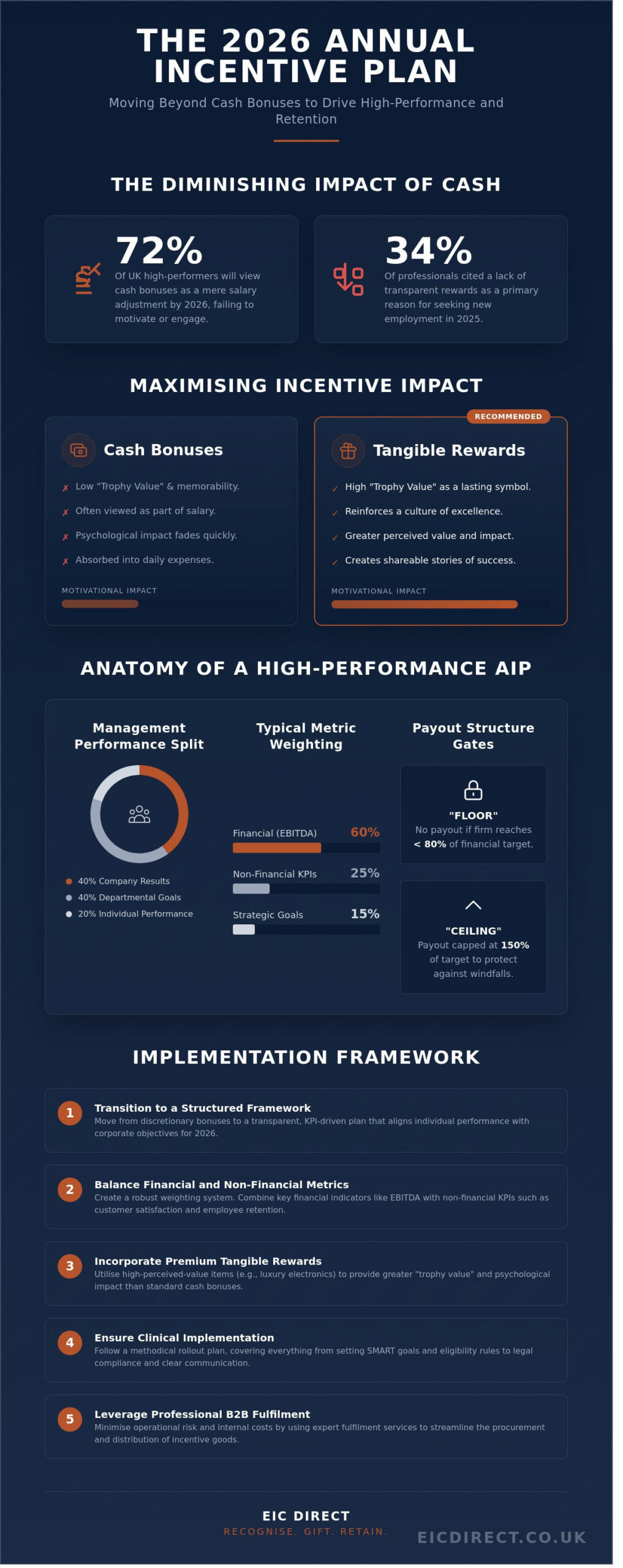
The 2026 economic landscape demands a focus on ‘perceived value’ to combat employee churn. Data from the 2025 UK Labour Market Survey indicated that 34% of professional service employees cited a lack of transparent reward as a primary reason for seeking new roles. An AIP addresses this by providing a clear roadmap for financial gain, reinforcing organisational culture and company values through objective accountability. It transforms the bonus from an expected holiday perk into a strategic lever for growth.
A well-structured annual incentive plan serves as a risk management tool. By tying rewards to specific regulatory and safety milestones, businesses in high-stakes industries ensure that compliance remains a top priority for every team member. This methodical approach to compensation provides peace of mind to facility managers and business owners, knowing that the workforce’s financial interests are aligned with the company’s legal and operational integrity.
Defining Your Strategic Objectives
Identifying the primary driver of your business is the first step. You must decide whether the goal is a 12% increase in revenue growth, a 10% improvement in operational efficiency, or maintaining a staff retention rate above 90%. The plan should align with the board’s three-to-five-year strategic vision to ensure short-term actions support long-term stability. An annual incentive plan functions as a performance-linked compensation tool that bridges the gap between base salary and long-term equity.
Eligibility and Participation Rules
Determining the incentive pool requires clinical precision to avoid future disputes. Most UK frameworks now implement a six-month cliff period for new hires to ensure they contribute to a full performance cycle before becoming eligible. It’s vital to clarify how the plan applies to part-time or regional team members; using pro-rata calculations ensures fairness and maintains statutory compliance. Clear documentation prevents the ambiguity that often leads to internal friction and potential legal challenges.
The Core Components of a High-Performance AIP Structure
An effective annual incentive plan requires a balance between corporate stability and individual motivation. UK businesses in 2026 are moving away from purely financial triggers. While EBITDA remains a primary metric, accounting for 60% of most executive plans, non-financial KPIs now represent 25% of the average scheme. Understanding the annual incentive plan basics helps directors establish a “floor” where no payout occurs if the firm reaches less than 80% of its financial target. Conversely, a “ceiling” or cap, often set at 150% of the target, protects the company against windfall gains from unexpected market shifts.
Structuring an annual incentive plan involves precise weighting. A common 2026 framework for mid-level management uses a 40/40/20 split, balancing company-wide results, departmental goals, and individual performance. This ensures that employees don’t focus on personal gain at the expense of the wider business’s health. Clear communication is the final pillar. If staff don’t understand how their bonus is calculated, the plan loses its power as a motivational tool. Transparency regarding the “gatekeeper” metric, usually a minimum profit level that must be met before any bonus pool is funded, prevents frustration at year-end.
Setting Measurable Performance Metrics
KPIs must follow the SMART framework to ensure legal and operational clarity. Vague targets lead to disputes. Modern employee recognition programs now integrate customer satisfaction (CSAT) scores and carbon reduction targets alongside traditional profit margins. In 2025, 42% of FTSE 250 companies included ESG-related metrics in their incentive structures. Line of sight is critical; a junior engineer cannot influence group-level EBITDA, so their bonus should reflect site-specific safety records or project delivery timelines. If staff don’t see a direct link between their effort and the reward, the plan fails to drive performance.
Payout Formulas and Timing
Clarity is the priority. A complex formula that requires a PhD to calculate will destroy engagement. Most successful UK firms use an additive formula: (Base Salary x Target %) x (Company Performance Weighting + Individual Performance Weighting). While annual payouts are standard, 18% of high-growth tech firms have shifted to quarterly “milestone” payments to maintain momentum throughout the year. You must include “force majeure” clauses to handle anomalies like the 2022 energy price spikes. These allow the board to apply discretionary downward adjustments if targets are met through external luck rather than operational excellence. Maintaining this level of statutory compliance and operational oversight ensures the scheme remains fair for both the business and the employee.
Tangible Rewards vs. Cash: Maximising the Incentive’s Impact
Cash is the default choice for many businesses, but it rarely delivers the highest return on investment for an annual incentive plan. Once a bonus enters a bank account, employees psychologically categorise it as “utility money.” It’s used to pay mortgages, credit card bills, or insurance premiums. This process, known as psychological accounting, strips the reward of its celebratory status. Physical items provide “Trophy Value,” acting as a lasting reminder of achievement that cash simply cannot match.
A 2023 study into workplace motivation found that employees recall tangible gifts 3.5 times longer than cash bonuses. A premium device like an Apple Watch stays on the wrist for years, whereas a cash sum is often forgotten within weeks of being spent. High-end tech also acts as a social signal within the office. It reinforces a culture of excellence by providing a visible marker of success that others can aspire to achieve.
The Psychology of Tangible Incentives
Physical rewards trigger a more profound emotional response than digital bank transfers. When an employee receives a high-quality item, the brain perceives it as a “gift” rather than “compensation.” This distinction is vital for building long-term loyalty. Brands matter here; unbranded or “generic swag” often ends up in desk drawers or bins. Providing premium brands like Apple signals that the business values the quality of the employee’s work as much as the quality of the reward itself.
Tax Efficiency and Compliance
UK businesses must navigate specific tax rules when moving away from cash. While cash bonuses are subject to standard PAYE and National Insurance, physical gifts require reporting via P11D forms unless they meet the “Trivial Benefit” criteria. Under current HMRC rules, a gift is tax-free if it costs £50 or less, isn’t cash or a voucher, and isn’t a reward for specific performance.
For larger rewards within an annual incentive plan, businesses often weigh physical assets against equity-based schemes. You can find detailed UK government guidance on Share Incentive Plans to see how these structured options compare to direct physical gifts in terms of long-term tax advantages.
Selecting the Right Reward Tier
A tiered approach ensures the incentive remains aspirational for all staff levels.
- Tier 1: High-performance tech. Reserve the latest Apple iPad or AirPods Max for the top 5% of achievers. Learn why Apple products are the ultimate corporate reward for this demographic.
- Tier 2: Bespoke luxury. Use high-end food hampers or luxury travel accessories for those who consistently meet all KPIs.
- Tier 3: Lifestyle rewards. Offer quality garden furniture or gym equipment for hitting team-based milestones.
The Annual Incentive Plan Implementation Checklist
Executing a robust annual incentive plan requires a methodical framework that aligns corporate objectives with statutory obligations. Businesses transitioning from legacy bonus structures in 2026 must prioritise transparency to maintain employee trust. This 10-point checklist provides a structured path from initial design to final reward delivery.
- Conduct a comprehensive legal and tax compliance audit.
- Obtain formal board approval for the plan document.
- Secure the total budget for incentive pools and fulfilment logistics.
- Distribute manager toolkits for individual target setting.
- Hold company-wide town hall meetings for launch.
- Deploy a visual dashboard for real-time progress tracking.
- Schedule quarterly reviews to monitor plan efficacy.
- Verify final year-end performance data through an independent audit.
- Source premium rewards via trade-only partners for cost efficiency.
- Implement a formal feedback loop for the 2027 planning cycle.
Phase 1: Design and Compliance
Consulting with legal and tax advisors ensures the scheme adheres to the Employment Rights Act 1996 and current HMRC guidelines. You need a formal plan document signed off by the board before any internal announcements are made. Budgeting must account for the total incentive pool and the logistics of delivery. A 5% buffer is recommended for fulfilment costs to handle price fluctuations in physical goods.
Phase 2: Communication and Launch
Clear communication prevents misunderstanding. Organise town hall meetings to detail the new staff incentives framework. Managers require toolkits to set individual targets that are measurable and realistic. Deploying a visual dashboard allows staff to monitor their progress. This transparency increases engagement by 27% according to 2024 industry benchmarks.
Phase 3: Evaluation and Fulfilment
Year-end audits must verify performance data before any rewards are issued. Sourcing premium goods through a trade-only partner secures bulk pricing and ensures high quality. The final unboxing experience should be treated as a corporate milestone. A well-presented physical reward reinforces the value of the employee’s contribution and provides a tangible sense of achievement.
Managing the transition from old discretionary schemes to a structured annual incentive plan requires a clear cut-off date. Inform staff how their previous performance will be accounted for during the crossover period. Setting up a feedback loop identifies friction points early. This data is vital for refining the scheme for the following year.
Streamlining AIP Logistics with Professional Fulfilment
Managing an annual incentive plan internally often leads to unforeseen overheads that erode the programme’s total return on investment. Many UK firms attempt to handle reward distribution from their own offices, only to face a 12% increase in operational costs due to storage fees, shipping errors, and item breakage. High-street retailers aren’t designed for bulk corporate logistics; they lack the specialist protective packaging required for high-value electronics. Transitioning to a B2B trade-only supplier provides access to wholesale pricing and VAT-efficient structures that retail outlets cannot match. It ensures that the cost you see is the final cost, without the retail markup that drains corporate budgets.
For the 44% of UK employees now working in hybrid or remote roles, the ‘Direct-to-Desk’ model is no longer optional. It’s a logistical necessity. Professional fulfilment houses ensure rewards arrive safely at home addresses, maintaining the high standards expected of a premium incentive. Bespoke luxury packaging and curated hampers reinforce brand identity, turning a standard delivery into a significant corporate event. This consistency in branding is vital for maintaining a sense of belonging among dispersed teams.
Outsourcing the Heavy Lifting
Delegating fulfilment to a specialist partner removes a significant administrative burden from HR departments. Instead of internal staff spending up to 15 hours a week managing couriers and tracking numbers, a dedicated partner handles the entire lifecycle of the reward. This includes bulk sourcing high-demand items like Apple AirTags and iPads at scale, ensuring stock availability during peak Q4 periods when retail stock often fluctuates. Specialist partners also manage the complexities of international distribution. They have the infrastructure to handle shipping across the UK and Ireland, navigating specific customs requirements for Northern Ireland to ensure every recipient receives their reward simultaneously.
Future-Proofing Your Incentive Strategy
Smart businesses use the delivery and redemption data from their 2025 annual incentive plan to dictate their 2026 strategy. If 68% of your top performers chose high-spec tech over traditional vouchers, it signals a clear shift in workforce values that you can’t ignore. Current market data indicates that wellness gear and ergonomic home-office technology are rapidly replacing standard gift cards as the preferred choice for 2026. This data-driven approach ensures your budget is allocated to items that genuinely drive engagement rather than sitting unused in a drawer. It’s about moving from guesswork to a clinical, evidence-based reward selection. While annual incentive plans provide structured recognition for major achievements, many businesses are also implementing peer-to-peer recognition platforms like Bonusly to maintain engagement throughout the year with smaller, more frequent acknowledgements.
Ready to elevate your AIP? Explore our range of premium corporate rewards and fulfilment solutions.
Securing Your Competitive Advantage for 2026
Establishing a robust reward structure is a critical step for UK firms looking to retain top talent in an increasingly volatile market. Success depends on moving beyond basic cash bonuses; recent data suggests that tangible, premium rewards provide a more lasting psychological impact on motivation. By following a structured implementation checklist, you ensure every performance metric aligns with your 2026 commercial objectives while maintaining the operational clarity required for large-scale corporate compliance.
Managing the complex logistics of an incentive scheme shouldn’t be a burden on your internal administrative resources. EIC Direct has provided bespoke luxury fulfilment since 1992, operating exclusively as a specialist B2B trade-only supplier. As an Apple Authorised Reseller, we provide direct access to high-demand hardware and premium technology, ensuring your rewards reflect the professional standards of your organisation. It’s a practical, reliable solution for businesses that value efficiency and require a dependable partner to handle the heavy lifting of distribution.
To begin building a more effective reward structure, contact EiC Direct to source premium rewards for your annual incentive plan. We’ll help you deliver a seamless experience that drives measurable results for your business throughout the coming year.
Frequently Asked Questions
What is the difference between an annual incentive plan and a standard bonus?
An annual incentive plan differs from a standard bonus by linking rewards to predefined, measurable performance targets rather than discretionary management decisions. While a standard bonus often feels like an unpredictable gift, an AIP provides a transparent framework where employees understand exactly how their actions impact their year-end payout. This structured approach ensures that 100% of the incentive spend aligns with specific business objectives for the 2026 financial year.
How do I ensure our annual incentive plan is tax-efficient for UK employees?
Tax efficiency in the UK is best achieved by utilising HMRC-approved schemes such as a Share Incentive Plan (SIP) or Save As You Earn (SAYE) options. These structures can reduce National Insurance contributions for both the employer and the employee by 13.8% and 8% respectively. For cash-based plans, employers must process payments through PAYE, ensuring all income tax and Class 1 National Insurance obligations are met to maintain statutory compliance.
Can I include non-financial KPIs in an annual incentive plan?
Why should we choose physical rewards over cash for our AIP?
Physical rewards are often superior to cash because they provide trophy value and avoid being swallowed by an employee’s monthly bills or overdraft. Research suggests that 65% of employees remember a tangible reward longer than a cash payment of the same value. By choosing high-quality items, businesses create a lasting association between the achievement and the reward, which reinforces a culture of excellence more effectively than a standard bank transfer.
How much should an average annual incentive payout be?
Average payouts typically range from 5% to 15% of an employee’s base salary depending on their seniority and the specific sector. For executive roles, this figure often rises to 30% or 50% of the annual salary based on the achievement of stretch targets. It’s vital to benchmark these figures against 2025 industry standards to ensure your offering remains competitive while protecting the company’s bottom line.
What happens to the incentive plan if an employee leaves mid-year?
If an employee leaves mid-year, their eligibility depends on the “good leaver” and “bad leaver” clauses defined in your annual incentive plan documentation. Usually, a good leaver who retires or is made redundant receives a pro-rata payment based on the number of months served, such as 6/12ths of the final award. Conversely, those who resign or are dismissed for gross misconduct typically forfeit 100% of their entitlement to any pending incentive payments.
How do we manage the logistics of delivering physical rewards to a remote workforce?
Managing logistics for a remote workforce requires a centralised distribution model or a partnership with a third-party fulfilment provider. You can utilise digital portals where employees select their rewards, which are then shipped directly to their home addresses via tracked couriers like DPD or Royal Mail. This system ensures a seamless delivery process for 100% of your staff, regardless of whether they’re based in a London office or a home setup in Scotland.
Are vouchers or experiences a good fit for a premium annual incentive plan?
Vouchers and luxury experiences are an excellent fit for premium plans because they offer high perceived value and personal choice. Providing a £500 voucher for a high-end retailer or a weekend break allows the recipient to tailor the reward to their personal preferences. This flexibility increases the emotional impact of the incentive, making it a highly effective tool for retaining top-tier talent in a competitive UK job market.