

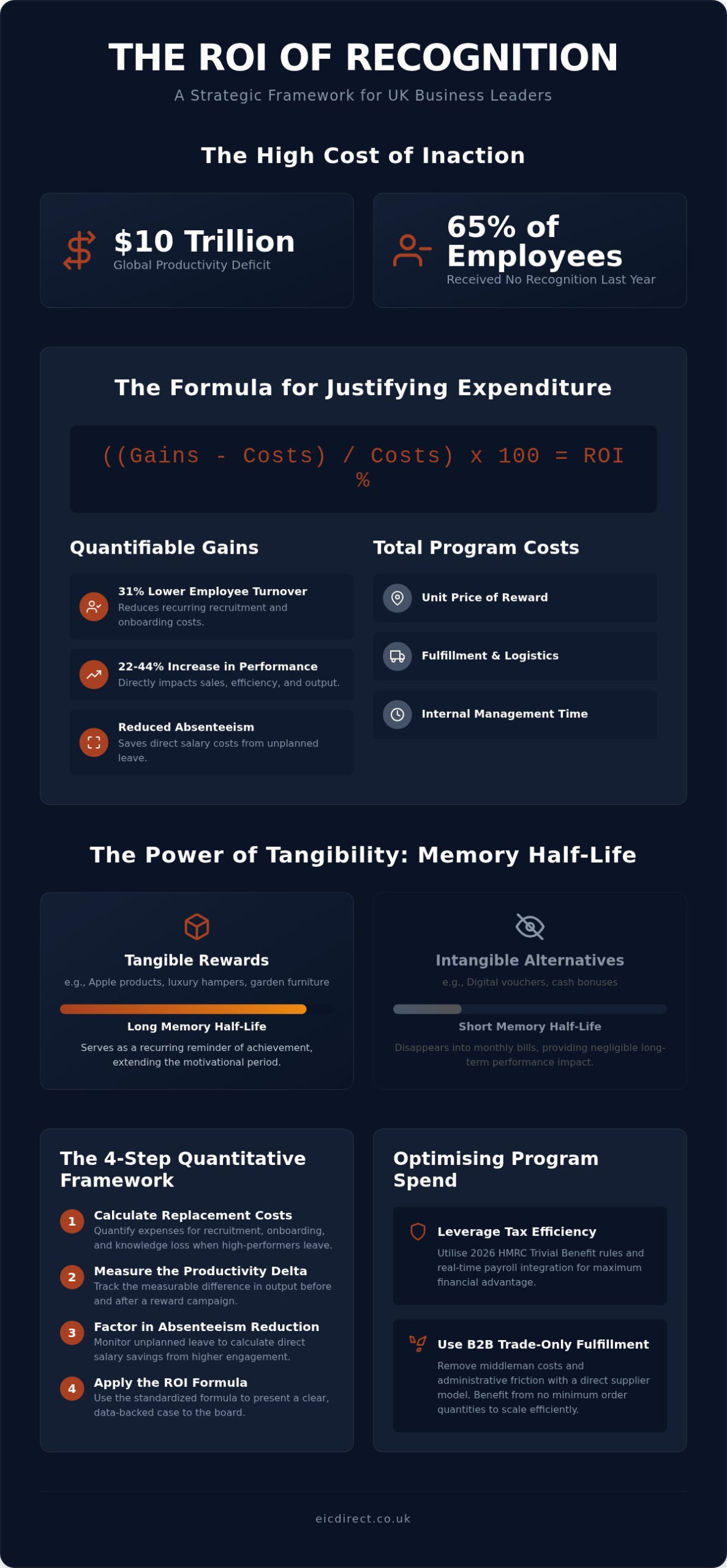
With 65% of employees reporting they received no recognition in the past year, the global economy is currently facing a $10 trillion productivity deficit. For UK business leaders, the challenge isn’t just acknowledging staff; it’s proving that these investments yield a tangible return. You’ve likely seen the limitations of digital vouchers and low-quality promotional items, which often fail to move the needle on engagement or retention. Calculating roi on staff incentives requires a shift from viewing recognition as a discretionary expense to treating it as a strategic operational requirement.
You understand that every pound spent must be justified to the board with clinical efficiency. This guide provides the precise framework you need to measure both the financial and cultural impact of your reward programs using 2026 professional metrics. We’ll explore how to leverage tax-efficient gifting under current HMRC real-time payroll reporting rules and why physical rewards, such as authorized Apple products or bespoke luxury hampers, offer a superior memory half-life compared to intangible alternatives. By the end of this article, you’ll have a clear ROI formula and a selection strategy designed to help achieve the 31% reduction in turnover seen by companies with a strong recognition culture.
Key Takeaways
- Establish a precise formula for calculating roi on staff incentives by measuring net profit gains against total program expenditure.
- Evaluate the ‘memory half-life’ of tangible rewards to ensure long-term engagement that outlasts the temporary impact of cash bonuses.
- Implement a quantitative framework using professional UK metrics like the Productivity Delta to justify recognition budgets to the board.
- Optimise program spend by leveraging 2026 HMRC Trivial Benefit rules and real-time payroll integration for maximum tax efficiency.
- Scale your recognition efforts using a B2B trade-only fulfillment model that removes middleman costs and offers no minimum order quantities.
The Fundamentals of Measuring Staff Incentive ROI
In the 2026 UK workplace, recognition has transitioned from a discretionary perk to a core strategic pillar. Calculating roi on staff incentives is no longer an exercise in guesswork; it’s a clinical measurement of financial performance. Fundamentally, ROI is the net profit generated by improved employee performance minus the total cost of the program. While many HR departments focus on Value on Investment (VOI), which tracks soft metrics like morale and sentiment, the board requires a hard Return on Investment (ROI) to justify expenditure. This distinction is vital for maintaining budget integrity in a high-stakes environment.
A critical factor in this calculation is the memory half-life of the reward. Digital vouchers or cash bonuses often disappear into monthly household bills, providing a negligible long-term impact on performance. Conversely, high-end physical goods like garden furniture, premium audio equipment, or kitchen accessories serve as a recurring reminder of achievement. This longevity extends the motivational period, effectively lowering the amortised cost of the incentive. For a foundational Incentive program overview, it’s clear that the choice of reward directly influences the duration of the performance uplift and the subsequent financial return.
Identifying Direct and Indirect Costs
Precision in calculating roi on staff incentives depends on identifying the true cost of acquisition. This must include the unit price of the reward, fulfillment, and logistics. Many businesses overlook the internal management time required to administer a program. Opting for a trade-only fulfillment solution with no minimum order quantity allows for scaling without the overhead of middlemen. Bulk procurement through a direct supplier lowers the initial investment threshold, ensuring a higher percentage of the budget reaches the employee rather than being lost to administrative friction.
Defining the ROI Objectives
Effective programs link incentives to specific, measurable KPIs such as sales growth, client retention, or operational efficiency. You must establish a baseline for employee turnover costs within your specific sector before launching a campaign. Research from Psychometrics indicates that companies with an established recognition culture experience 31% lower employee turnover. This reduction in turnover directly lowers the recurring cost of recruitment and onboarding. By focusing on high-impact rewards like Apple AirPods or bespoke luxury hampers, you ensure the recognition is perceived as significant enough to drive these critical business outcomes.
The Quantitative Framework: Metrics that Drive Financial Return
For eCommerce brands looking to align these productivity gains with broader strategic objectives, eComQB provides the consulting and technology solutions necessary to accelerate growth.
Quantifying the financial impact of recognition requires a structured approach. You shouldn’t rely on sentiment alone when the board demands hard data. Step one involves calculating the cost of replacement for high-performing staff. When a key employee leaves, your business incurs expenses for recruitment, onboarding, and the temporary loss of institutional knowledge. Step two measures the productivity delta. This is the measurable difference in output before and after a high-end reward campaign. According to an IRF meta-analysis of Research and Best Practices, well-designed programs can increase performance by 22% to 44%.
Step three is factoring in absenteeism reduction. Disengaged staff historically take more unplanned leave; a robust recognition culture lowers these absences, saving the business direct salary costs. Step four is the application of the standard ROI formula: ((Gains – Costs) / Costs) x 100. When calculating roi on staff incentives, you’ll find that premium tech like Apple AirPods yields a higher return than generic alternatives. Generic items often suffer from high failure rates or remain unused, whereas premium brands maintain a high perceived value and a longer functional life. This durability ensures the ‘memory half-life’ mentioned earlier remains high, protecting your investment.
Measuring Productivity and Performance Gains
In sales-driven roles, the link between incentives and output is direct. You can track specific increases in lead conversion or revenue following the launch of a campaign. For remote workers, the impact is often seen in operational efficiency. High-end audio equipment and tablets aren’t just rewards; they’re functional tools that improve the daily work experience. Using well-structured employee recognition programs allows you to drive specific cultural outcomes while maintaining operational clarity. Many managers find that securing direct trade-only pricing ensures these productivity gains aren’t eroded by excessive procurement markups.
Retention Metrics and Talent Attraction
Premium physical prizes differentiate your Employee Value Proposition (EVP) in a crowded 2026 market. The ‘Retention Dividend’ of milestone awards, such as luxury watches or high-end garden furniture, is significant. These tangible items serve as permanent markers of career progression. They actively combat ‘quiet quitting’ by making employees feel valued through high-quality, durable goods. When you compare the cost of a premium watch to the expense of replacing a senior manager, the financial benefit of retention becomes undeniable.
Optimising ROI with Tax-Efficient Physical Rewards
When calculating roi on staff incentives, tax efficiency is a primary lever for protecting your corporate margin. Cash bonuses are subject to Income Tax and National Insurance, which often erodes the recipient’s perceived value by up to 40%. Vouchers carry a significant hidden ‘sunk cost’ through unredeemed digital credits. Industry data suggests approximately 20% of voucher value is never utilised by staff, representing a total loss of investment for the business. Physical rewards bypass these pitfalls. By providing premium items like Apple iPads or bespoke luxury hampers, you ensure the full value of the investment reaches the employee without the friction of payroll deductions or redemption barriers.
The Trivial Benefits Advantage
HMRC’s Trivial Benefits rule remains a vital tool for structured recognition. Under 2026 regulations, rewards costing £50 or less are tax-free, provided they are not cash or cash equivalents. This allows for the strategic delivery of tangible rewards throughout the financial year without triggering a benefit-in-kind tax liability. To maintain absolute compliance, these gifts must not be a contractual obligation. They are ideal for milestone-based recognition. Using a direct trade-only supplier ensures you can access high-quality items, such as custom branded power banks, while staying strictly within this £50 threshold.
Perceived Value vs. Actual Cost
The psychological impact of a physical gift far outweighs its unit cost. Unboxing a premium brand, such as professional golf equipment or Apple AirPods, creates a lasting positive association that cash cannot replicate. Because the recipient does not see a tax deduction on their payslip, the gift is perceived as a 100% bonus. Our direct trade-only pricing model maximises the gap between your actual procurement cost and the high retail value perceived by the staff member. This strategic leverage ensures your budget works harder, delivering a premium experience that reinforces long-term loyalty. To explore how our pricing model supports your budget, you can view our premium B2B catalogue here.
Partnering for Profit: Scaling ROI with Trade-Only Fulfillment
Scaling a recognition program from a pilot phase to a company-wide initiative requires a streamlined supply chain. When calculating roi on staff incentives, many managers fail to account for the margin erosion caused by middlemen and excessive platform fees. Utilizing direct prize fulfilment services ensures that your budget is spent on the reward itself rather than software overheads. This direct model provides the operational clarity needed to maintain a high cost-to-value ratio while ensuring that every pound invested translates into a tangible employee benefit.
Operational efficiency is further enhanced by selecting a partner with no minimum order quantity (MOQ). This flexibility allows you to run bespoke, high-impact campaigns for small departments or specific milestones without committing to bulk stock that might become obsolete. Real-time inventory management is equally critical; it prevents the hidden costs and disappointment of out-of-stock substitutions. The logistics of the delivery itself contribute to the ‘First Impression’ ROI. A premium item, such as an Apple iPad or a bespoke luxury hamper, must arrive in perfect condition to reinforce the brand’s commitment to quality and excellence.
Selecting a High-Stakes Rewards Partner
Specialist B2B trade-only suppliers offer a level of reliability and technical precision that consumer retailers cannot match. When managing staff incentives, you require a partner who understands UK regulatory frameworks and the importance of professional delivery. Authorized suppliers of Apple AirPods and AirTags provide a guarantee of authenticity that protects your corporate reputation. Reliability in fulfillment ensures that the performance gains identified in your ROI model aren’t undermined by logistical failures or poor-quality goods.
Future-Proofing Your Incentive Strategy
As we move through 2026, reward trends are shifting toward high-utility executive lifestyle gifts. Items like professional garden furniture, high-end audio systems, and premium home appliances are seeing increased engagement as employees prioritize their home and leisure environments. To future-proof your strategy, you should iterate your ROI model quarterly based on 2026 performance data. This allow you to pivot your reward selection toward categories that drive the highest productivity delta. Before presenting your case to the board, ensure you have a final checklist covering verified recruitment savings, tax-efficient allocation under HMRC rules, and direct procurement costs to demonstrate absolute financial control.
Secure Your Competitive Advantage through Strategic Recognition
The 2026 business landscape demands a clinical approach to employee engagement. Moving beyond the ‘sunk cost’ of unredeemed vouchers and taxed cash bonuses is essential for protecting your corporate margin. By focusing on the productivity delta and the long memory half-life of premium physical goods, you transform recognition from a discretionary expense into a measurable driver of profit. Calculating roi on staff incentives becomes a straightforward process when you leverage HMRC Trivial Benefits and direct procurement models to eliminate unnecessary middleman fees.
As a specialist B2B trade-only supplier and authorized Apple corporate rewards partner, we provide the infrastructure needed to scale your programs with expert UK prize logistics and fulfillment. Maximise your incentive ROI with EiC Direct’s trade-only premium rewards. Taking these steps ensures your recognition strategy is both legally compliant and financially robust. You’re now equipped to present a compelling, data-driven case to the board that secures long-term talent retention and operational excellence.
Frequently Asked Questions
What is the standard ROI for a staff recognition program in the UK?
Standard ROI for UK programs typically manifests as a 22% to 44% increase in performance, according to IRF research. When calculating roi on staff incentives, you must baseline current productivity against the uplift observed post-campaign. While specific financial returns vary by industry, the primary drivers are reduced turnover and increased output. Board-level reporting should focus on these hard financial gains rather than purely qualitative feedback to ensure ongoing budget approval.
How do I calculate the ROI of non-monetary incentives like luxury hampers?
Calculating the ROI of non-monetary items like luxury hampers requires measuring the Productivity Delta. This involves tracking the net profit generated by an employee’s improved performance and subtracting the direct procurement cost of the reward. Because physical goods like hampers or garden tools have a higher perceived value than their trade-only cost, the return is often superior to taxed cash bonuses which staff frequently view as standard salary.
Are physical staff rewards more tax-efficient than cash bonuses?
Physical rewards are significantly more tax-efficient than cash bonuses due to HMRC’s Trivial Benefits rules. As of 2026, non-cash gifts costing £50 or less are exempt from tax and National Insurance, provided they aren’t performance-related or contractual. Cash bonuses, conversely, are subject to full payroll deductions. This means a £50 physical reward delivers 100% of its value to the employee, whereas a cash bonus is eroded by up to 40%.
How does employee retention impact the overall ROI of an incentive scheme?
Employee retention is a primary driver of incentive ROI. Psychometrics data shows that recognition cultures experience 31% lower turnover, which directly eliminates the high costs of recruitment and onboarding. By providing tangible rewards like Apple AirPods or high-end audio equipment, you increase the ‘retention dividend’. These durable items remind staff of their value daily, effectively lowering the amortised cost of the incentive through extended tenure and reduced replacement expenditure.
Can I claim VAT back on premium staff incentives like electronics?
Businesses can generally reclaim VAT on the purchase of staff incentives as a legitimate business expense. However, HMRC rules dictate that if the total value of gifts to an individual exceeds £50 in a 12-month period, output VAT may become due. For premium electronics or luxury goods, it’s essential to coordinate with your finance department to ensure compliance with current 2026 VAT thresholds while maximising the input tax recovery on bulk trade procurement.
What is the difference between ROI and VOI in human resources?
ROI (Return on Investment) measures the hard financial gain, such as increased revenue or saved recruitment costs, relative to the program’s expense. VOI (Value on Investment) focuses on intangible benefits like morale, brand advocacy, and cultural alignment. While VOI provides peace of mind regarding the workplace environment, the board typically requires a clinical ROI calculation when calculating roi on staff incentives to justify the allocation of capital toward high-end rewards.