

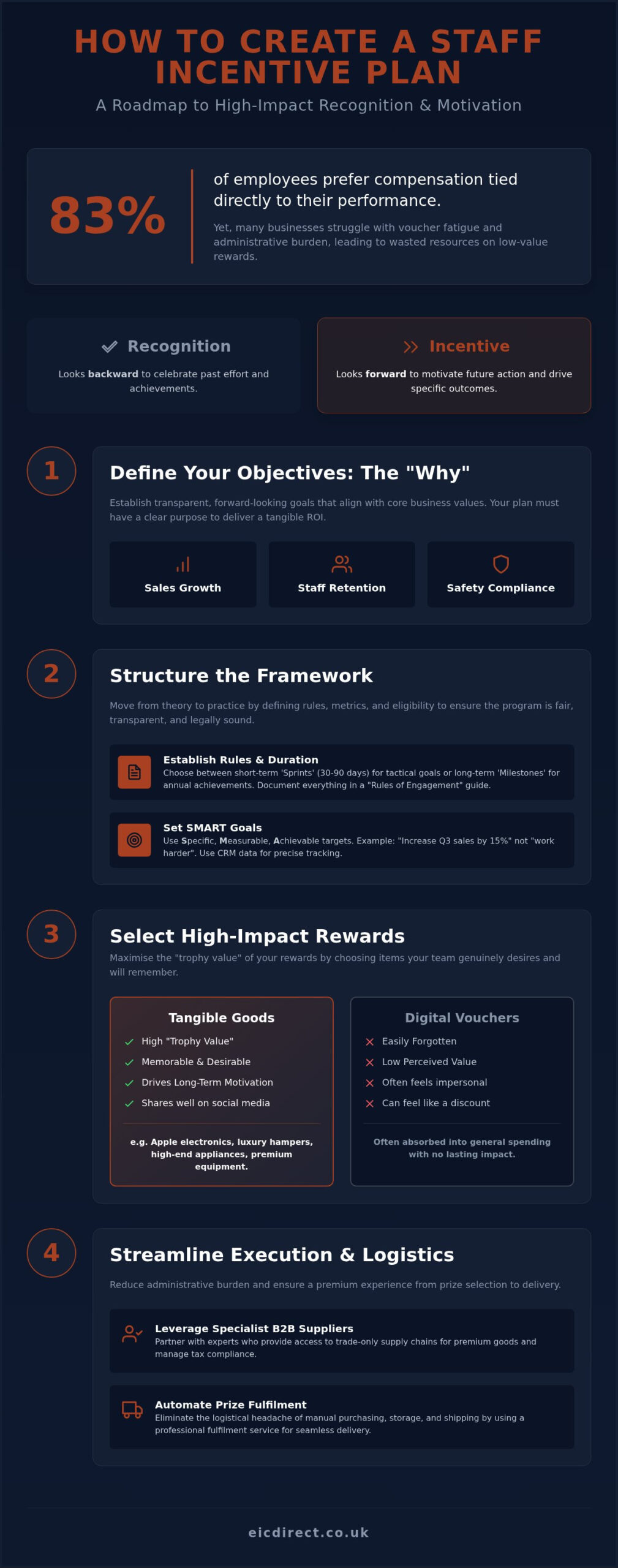
83% of employees now prefer their compensation to be tied directly to their performance, yet many leaders still struggle with the technicalities of how to create a staff incentive plan that actually works. You’ve likely seen the signs of voucher fatigue or felt the administrative burden of managing rewards that your team doesn’t actually value. It’s a common challenge to balance a strict budget with the need for high-impact recognition that drives measurable results without wasting resources on low-perceived-value items.
This article provides a definitive roadmap for designing, launching, and fulfilling a plan that uses premium tangible rewards to boost engagement scores. We’ll show you how to move away from the logistical headache of manual fulfilment by adopting a streamlined B2B approach. You’ll learn the specific steps to integrate high-value items, such as Apple electronics or bespoke luxury hampers, into your 2026 strategy. By the end of this guide, you’ll have the expertise to manage corporate liability and tax compliance while delivering a reward program that your staff truly respects.
Key Takeaways
- Understand the foundational steps of how to create a staff incentive plan, starting with the identification of core objectives such as sales growth or safety compliance.
- Develop a clear operational framework that defines participation eligibility and distinguishes between short-term performance sprints and long-term annual milestones.
- Maximise the “trophy value” of your rewards by prioritising high-impact tangible goods, such as Apple electronics or bespoke food hampers, over easily forgotten digital vouchers.
- Optimise your logistics and reduce administrative burden by leveraging professional prize fulfilment services and trade-only supply chains for seamless delivery.
Defining Your Objectives: The Foundation of a Staff Incentive Plan
A staff incentive plan is a structured framework designed to drive specific business outcomes by offering curated rewards for predefined achievements. It’s a forward-looking strategy. While many businesses confuse this with simple recognition, there’s a distinct difference. Recognition looks backward to celebrate past effort; an incentive looks forward to motivate future action. Understanding this distinction is critical when learning how to create a staff incentive plan that delivers a tangible return on investment.
The “Why” behind your plan must be transparent. Common objectives include driving sales growth, improving staff retention, or ensuring safety compliance in high-risk environments. A well-designed incentive program doesn’t operate in a vacuum. It should complement your broader employee recognition programs to provide a comprehensive motivational ecosystem. This alignment ensures that every reward reinforces the company’s core values and long-term targets.
Setting SMART Goals for Performance
For a plan to succeed, goals must be Specific, Measurable, and Achievable. A vague target like “work harder” won’t suffice. Instead, aim for concrete KPIs, such as a 15% increase in Q3 sales or a 10% reduction in warehouse incidents. Use CRM data or internal engagement surveys to track progress with clinical precision. While “stretch goals” are useful for high performers, they must remain achievable. If a target feels impossible, it will demotivate your team rather than inspire them. This methodical approach provides the peace of mind that your budget is being used effectively.
Identifying Your Target Audience
Not all staff members are motivated by the same rewards. Successful plans segment the workforce by department and demographic. A sales team might respond to competitive high-ticket items like premium Apple electronics, while back-office support may value high-end home appliances or bespoke luxury hampers. Learning how to create a staff incentive plan also involves tailoring the “entry price” of the reward to the task’s difficulty. For instance, Gen Z employees often prioritise tech-driven rewards like AirPods, whereas executive-level staff might prefer professional golf equipment or luxury watches. Matching the reward to the audience ensures the incentive carries genuine weight and drives engagement.
Structuring the Framework: Rules, Metrics, and Eligibility
Structuring the operational framework is the next critical phase in how to create a staff incentive plan. This stage moves beyond theory into practical administration to ensure the program is both legally sound and mathematically viable. You must first determine the plan’s duration. Short-term “sprints”, often lasting 30 to 90 days, are effective for immediate tactical goals. Annual milestones are better suited for long-term retention and significant project completions. Clear eligibility criteria are essential for maintaining transparency; if staff feel the selection process is arbitrary, engagement will plummet.
Choose a calculation method that aligns with your data capabilities. Quota-based systems reward everyone who hits a specific target, while ranking systems foster competition by rewarding only the top performers. Threshold models ensure that a baseline of performance is met across the board before any rewards are triggered. Documentation is your primary tool for risk management. A formal “Rules of Engagement” document prevents disputes and ensures alignment with UK employment law and HMRC reporting requirements regarding benefits in kind.
Establishing a realistic budget is the final pillar of the framework. According to Mercer (2026), the average total salary increase budget is projected to be 3.5%. Your incentive spend should be partitioned from these figures to ensure it remains a performance-driven variable rather than a fixed cost. Partnering with a specialist B2B supplier ensures that your budget accounts for both the cost of premium goods and the logistical complexities of fulfilment, preventing unexpected overheads from eroding your ROI.
Selecting the Right Incentive Model
Communication and Launch Strategy
The success of your launch depends on clarity. Focus the announcement on the “What’s in it for me?” factor to capture immediate interest. Managers must be trained to promote the plan effectively, acting as the first point of contact for staff queries. Creating a sense of urgency through visual teasers of premium prizes, such as high-end audio equipment or luxury watches, can build the anticipation necessary for a high-impact rollout.
Selecting High-Impact Rewards: Tangible Goods vs. Vouchers
A primary error in many corporate strategies is the over-reliance on digital vouchers or cash bonuses. While these are easy to distribute, they often suffer from “voucher fatigue.” Digital codes are frequently forgotten in email inboxes or, worse, spent on mundane household essentials like groceries. This dilutes the motivational impact. When you’re determining how to create a staff incentive plan, the goal is to provide a lasting reminder of achievement. This is where the concept of “trophy value” becomes essential. Physical prizes serve as a constant, visible symbol of success that cash simply cannot replicate.
The choice of brand is equally important. Generic technology often lacks the prestige required to drive high-level performance. Offering premium brands, such as Apple AirPods or iPads, carries significantly more weight with a professional workforce. For VIP recognition or major milestones, bespoke luxury food hampers or high-end watches offer a level of exclusivity that reinforces an employee’s value to the organisation. You can source these premium rewards directly through a trade-only partner to ensure authenticity and wholesale value.
The Psychology of Physical Prizes
Physical goods trigger the “Endowment Effect,” where individuals place a higher value on items they can physically touch and own compared to digital credits. There is also the element of social proof. An iPad or a high-end coffee machine on a desk is a visible reminder of success to the entire team. It creates a narrative of reward that persists long after the initial announcement. The unboxing experience itself adds a layer of sensory recognition that a PDF attachment cannot match. These moments are key when considering how to create a staff incentive plan that resonates emotionally and professionally.
Curating a Premium Reward Catalog
Your catalog should reflect the diversity of your workforce. For tech-focused roles, sourcing branded premium electronics for business like noise-cancelling headphones ensures the reward is both functional and desirable. Lifestyle rewards, such as garden furniture or luxury cookware, appeal to those prioritising home life. For high-flyers reaching significant career milestones, professional golf equipment or designer luggage provides the “big ticket” impact that maintains long-term loyalty. This variety ensures that tangible rewards remain the superior choice for modern recognition.
Execution and Logistics: Ensuring Seamless Fulfilment
Execution and logistics represent the most significant operational hurdle when considering how to create a staff incentive plan. While many guides dismiss fulfilment as a simple shipping step, the reality of B2B logistics requires a more methodical approach. To maintain budget efficiency, you should partner with a trade-only specialist. This provides direct access to premium stock and wholesale pricing that retail-facing suppliers cannot match. Reliability is paramount; a delayed reward diminishes the psychological impact of the achievement and can lead to employee frustration.
Managing scalability is equally important. Many incentive programs fail because they’re tied to rigid minimum order quantities (MOQs). A partner offering no MOQ allows for bespoke scaling, whether you’re rewarding a single high-flyer or an entire department. Utilising prize fulfilment services eliminates the administrative friction of storage and manual dispatch. This professional oversight ensures that your internal resources remain focused on core operations while the complex logistics of individual shipping are handled with clinical efficiency.
Compliance with UK tax regulations is a mandatory consideration for any corporate program. While Trivial Benefits offer some relief for non-performance-related gifts under £50, performance-based incentives usually require P11D reporting or a PAYE Settlement Agreement (PSA). Handling these corporate liabilities correctly is a legal necessity. A competent partner will provide the transparent data required for your finance team to meet these obligations without fuss, ensuring your program remains compliant with current health, safety, and financial legislation.
Streamlining the Logistics Chain
Efficiency in the logistics chain relies on automation. The delivery process should be integrated so rewards arrive at the employee’s door immediately after the win is verified. By outsourcing prize sourcing and dispatch, you reduce administrative “friction” and lower the internal cost of managing the program. This allows for more accurate tracking of ROI. You can correlate reward spend directly against KPI improvements, providing a clear path to resolution for any budget concerns raised by stakeholders during the 2026 planning cycle.
The Direct-to-Employee Advantage
In a modern workforce, shipping rewards directly to an employee’s home is a strategic necessity. This is particularly effective for remote workers, as it provides a personal touch that digital credits lack. The packaging must reflect your brand’s standards; generic boxes don’t convey the same level of prestige as a professionally fulfilled premium item. It’s vital to select a partner that avoids low-value “swag” like mugs or keyrings. Instead, focus on luxury items like high-end home appliances or professional audio equipment. This ensures that the unboxing experience reinforces the high-stakes nature of the achievement and fits the professional narrative of your business.
Driving Performance with Strategic Reward Fulfilment
Mastering how to create a staff incentive plan requires a shift from simple administrative management to strategic reward selection. By moving away from digital vouchers and focusing on high-impact tangible goods, you ensure that your recognition efforts carry lasting trophy value. A successful 2026 strategy relies on clear SMART objectives, a transparent eligibility framework, and a logistical chain that prioritises reliability and professional standards.
Managing the complexities of bulk fulfilment and tax compliance doesn’t have to be a burden on your internal resources. Partnering with a specialist ensures your team receives premium rewards that drive measurable engagement without the logistical friction of storage or manual shipping. You can Discover Premium B2B Rewards for Your Incentive Plan at EiC Direct. As a direct supplier of Apple iPads and AirTags, we provide specialist B2B trade-only fulfilment with no minimum order quantities for maximum flexibility.
Establishing a robust incentive program is a sound investment in your company’s operational stability and future growth. With the right rewards and a streamlined fulfilment process, you can achieve higher performance scores and a more motivated workforce throughout the year.
Frequently Asked Questions
What is the most effective type of employee incentive?
Tangible rewards with high “trophy value” are the most effective for driving measurable performance. Since 83% of employees prefer their pay to be tied directly to their output, linking premium electronics or luxury goods to specific KPIs ensures the reward is both desirable and memorable. Unlike cash, which is often absorbed into daily living costs, physical items serve as a lasting symbol of achievement.
How do I calculate the budget for a staff incentive plan?
Budgeting requires a backward-calculation starting from your target ROI. While salary budgets for 2026 are projected to increase by 3.5% on average, incentive funds should be treated as a separate performance-driven pot. You must factor in the wholesale cost of the rewards and the total cost of fulfilment, including shipping and storage. This methodical approach is essential when learning how to create a staff incentive plan that remains profitable.
Are physical rewards taxable for employees in the UK?
Performance-based physical rewards are generally considered a benefit in kind and are subject to tax. Most professional organisations manage this corporate liability through a PAYE Settlement Agreement (PSA). This allows the employer to cover the tax and National Insurance contributions on behalf of the staff, ensuring the recipient enjoys the full value of the prize without any unexpected financial burden.
How long should an incentive program run to be effective?
Duration should be dictated by the specific business objective. Tactical “sprints” aimed at immediate sales targets are most effective when they last between 30 and 90 days to maintain high energy levels. Conversely, programs focused on staff retention or long-term safety compliance should be structured around annual milestones. This variety is a key component of how to create a staff incentive plan that sustains engagement throughout the year.
Why should I choose physical goods over cash or vouchers?
Physical goods trigger the “endowment effect,” where employees place a higher psychological value on items they can physically own. Vouchers often suffer from “fatigue” and are frequently spent on mundane essentials like groceries, which dilutes their impact as a reward. Premium items, such as Apple AirPods or luxury hampers, provide social proof and a visible reminder of success that persists long after a cash bonus has been spent.
What are ‘Trivial Benefits’ and how do they apply to incentives?
Trivial Benefits are tax-free gifts provided to employees that cost £50 or less, including VAT. To qualify, the gift must not be a reward for work performance or part of the employee’s contract. While they’re useful for seasonal gestures or birthdays, they’re not applicable to high-impact incentive plans. Performance-driven programs require more robust rewards that fall outside the Trivial Benefit scope and must be reported via standard HMRC frameworks.