

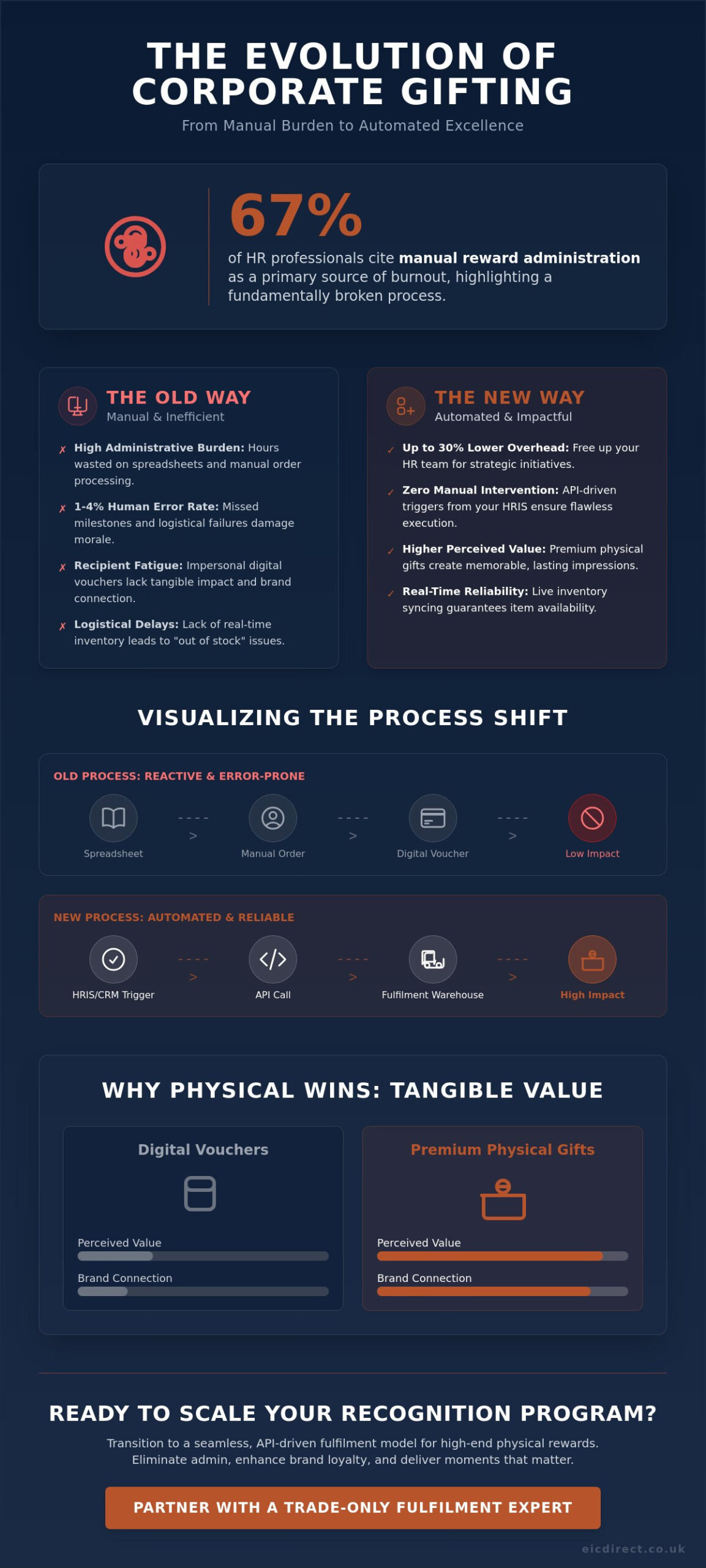
The standard approach to corporate recognition is fundamentally broken; a 2023 industry survey found that 67% of HR professionals cite manual reward administration as a primary source of burnout. You’ve likely identified the limitations of digital vouchers, which often lead to recipient fatigue and a lack of tangible brand connection. Transitioning to automated gifts shouldn’t mean sacrificing the quality of high-end physical items like Apple AirPods or bespoke luxury hampers. It’s a logistical requirement that requires a shift from manual oversight to a robust, integrated fulfilment engine.
This guide demonstrates how to scale your recognition programs while reducing internal overhead by up to 30%. You’ll discover how to integrate physical rewards directly with your existing CRM or HR systems to ensure every high-performing staff member receives a premium item without manual intervention. We’ll examine the technical requirements for 2026, focusing on the guaranteed delivery of electronics, home appliances, and luxury goods to maintain your professional reputation and operational efficiency.
Key Takeaways
- Transition from manual spreadsheets to API-driven systems that link your HRIS directly to professional fulfilment warehouses.
- Learn why physical rewards offer a higher perceived value than digital codes and how to scale automated gifts with zero administrative overhead.
- Ensure operational reliability by implementing real-time inventory syncing for premium electronics and high-end luxury items.
- Navigate statutory compliance requirements, including GDPR and UK tax regulations, to maintain a legally robust recognition program.
- Streamline your supply chain through a direct, trade-only fulfilment model that eliminates unnecessary middlemen and logistical delays.
Defining Automated Gifting for the Modern Enterprise
Automated gifting represents a fundamental shift in corporate reward strategy. It moves from reactive, manual processes to a programmatic framework where physical rewards are dispatched based on specific data triggers. This evolution is a direct extension of marketing automation principles, applied to internal recognition and external loyalty programs. By integrating your rewards program with an API-driven system, you ensure that automated gifts are delivered with clinical precision, removing the risk of human error or administrative delay.
The Move Away from Manual Recognition
Spreadsheets and manual tracking are no longer viable for high-stakes corporate recognition. A typical enterprise managing rewards via manual input faces a significant administrative burden; research indicates that manual data entry has an average error rate between 1% and 4%. For a UK enterprise with 5,000 employees, this leads to dozens of missed milestones or logistical failures annually. These “recognition gaps” damage morale and undermine the program’s intent. Scaling a national reward strategy requires a system that functions without manual oversight, ensuring that every work anniversary, sales milestone, or client loyalty tier is met with an immediate, physical response.
Software vs. Fulfilment: The Two Pillars of Automation
Distinguishing between the software trigger and the physical fulfilment engine is critical for program success. Many businesses mistake a software platform for a complete solution. While a platform manages the “choice” and the “trigger,” it’s the trade-only fulfilment partner that handles the “delivery” of high-end goods. This distinction is vital when moving beyond generic vouchers toward premium rewards. A fulfilment-led strategy prioritises the inventory and logistics of tangible items, such as Apple iPads, bespoke luxury food hampers, or high-end garden furniture.
The 2026 corporate landscape demands a more sophisticated approach than simple digital codes. Modern enterprises now utilise API integrations to connect HRIS platforms like Workday or HiBob directly to a professional warehouse. This ensures that when a data trigger is met, the physical item is picked, packed, and dispatched automatically. Automated gifting is a synthesis of data-driven triggers and reliable physical prize logistics.
To achieve this level of operational efficiency, many brands rely on the expertise of third-party logistics providers such as EZ3PL Ltd to manage the complex fulfilment journey from the warehouse to the recipient.
- Programmatic Triggers: Automated rewards based on real-time CRM or HRIS data.
- API-Driven Recognition: Direct communication between your software and the fulfilment warehouse.
- Fulfilment-Led Strategy: Prioritising the reliable delivery of high-end physical goods over low-impact digital vouchers.
The Mechanics of Automated Prize Fulfilment and Inventory Syncing
The reliability of a reward program depends on the technical synergy between your management software and the physical warehouse. For automated gifts to function without friction, a real-time data exchange is mandatory. This process eliminates the lag between a milestone being reached and the reward being dispatched. It moves the operation away from manual batch processing into a continuous, event-driven model that mirrors the precision required in statutory electrical inspections.
API Integration and HRIS Connectivity
Modern automation relies on a seamless “handshake” between HRIS platforms like Workday or HiBob and the fulfilment partner’s system. When an employee’s status changes in your database, a secure API call triggers the prize allocation. For example, once a “probation passed” status is logged, the system can instantly initiate the dispatch of Apple AirPods or a custom branded power bank. This direct link ensures that rewards are delivered while the achievement is still fresh. It’s a clinical process that treats recognition with the same level of operational clarity as a remedial works report. Data security is central to this exchange; all transmissions must adhere to ISO 27001 standards to ensure employee privacy and GDPR compliance.
Real-Time Stock Management for Premium Brands
Inventory accuracy is the most common failure point in automated systems. A 2024 logistics industry report highlighted that 34% of businesses experienced “out of stock” issues during peak recognition periods, such as the end of the financial year. This is unacceptable when dealing with high-demand items like professional golf equipment, iPads, or luxury food hampers. Our system maintains real-time synchronisation to ensure that every item listed in your portal is physically present in the warehouse at the moment of the trigger.
By removing minimum order quantities, we allow for a truly scalable model. A single unit of high-end audio equipment can be dispatched as efficiently as a bulk order of garden tools. This flexibility is essential for national UK enterprises that need to reward individual achievements across multiple sites without maintaining their own costly inventory. If you are looking to streamline your internal processes and eliminate logistical failures, you can view our trade-only catalogue to see how we support high-volume, automated fulfilment with absolute reliability.
- No Minimum Order Quantity: Scale your program from a single recipient to thousands without logistical penalties.
- Event-Driven Dispatch: Rewards are triggered by real-time data, not manual spreadsheets.
- Inventory Integrity: Direct warehouse syncing prevents the embarrassment of “out of stock” notifications for premium rewards.
Premium Tangible Goods vs. Automated Vouchers: Why Physical Wins
The 2026 corporate landscape is saturated with digital noise. Digital vouchers, once considered convenient, now contribute to “reward invisibility.” A 2024 report from the Incentive Research Foundation indicates that physical rewards generate a 40% higher memorability score compared to digital equivalents. When automated gifts are delivered as tangible items, they provide a sensory experience that a PDF code cannot replicate. The weight of a luxury watch or the unboxing of a high-end audio speaker creates a psychological anchor between the recipient and the organisation. It’s a matter of professional impact; a physical item occupies space in the recipient’s life, whereas a digital code is often lost in an overflowing inbox.
The ROI of Tangible Rewards
Physical goods offer a distinct “trophy value” that extends far beyond the point of delivery. While a voucher is spent and forgotten, a premium item remains in the recipient’s home or workspace as a permanent mark of achievement. This visibility is a key driver in high-end employee rewards, where the goal is long-term retention rather than a fleeting interaction. For instance, a high-performing sales lead who receives an iPad or professional golf equipment is reminded of their value to the firm every time they use that item. A 2025 analysis of UK corporate reward schemes suggests that enterprises using physical rewards see a 12% improvement in staff loyalty scores over a 24-month period.
Bypassing the Generic Swag Trap
The effectiveness of a rewards program is compromised when the quality of the item doesn’t match the seniority of the recipient. High-level executives and key clients view generic items like mugs or keyrings as a lack of professional respect. To maintain a position of authority, businesses must focus on branded premium electronics for business or bespoke luxury food hampers. These items signal a commitment to quality and a meticulous attention to detail.
Premium electronics, such as Apple AirPods or custom branded power banks, serve as the gold standard for automated sales incentives. They provide immediate utility and align with the professional standards of a modern enterprise. For senior executives and top performers, high-end audio rewards offer a particularly sophisticated option that resonates with professionals who expect a reward commensurate with their contribution. Similarly, for client retention, a luxury hamper or high-end homewear offers a level of sophistication that digital alternatives lack. By automating the delivery of these high-value items, you ensure that your most important stakeholders receive a reward that reflects their contribution to the business’s success without the administrative friction of manual selection.
Implementing a Compliant Automated Gift Strategy
Operational excellence in automated gifts requires more than just a software trigger; it demands a rigorous adherence to legal and logistical standards. When shifting to a programmatic delivery model, businesses must treat recipient data with the same level of statutory compliance as financial or safety records. Failure to secure address data or manage tax obligations can transform a reward program into a significant corporate liability. A methodical approach ensures that every dispatch meets both UK regulatory requirements and the high expectations of the recipient. This involves a clinical focus on data integrity and the physical security of high-value goods during transit.
Regulatory Compliance and Data Safety
Handling employee or client address data carries a distinct Duty of Care under GDPR. An automated system must ensure that data handshakes between your CRM and the fulfilment partner are encrypted and purged post-dispatch. According to 2024 data from the Information Commissioner’s Office (ICO), misdirected physical mail accounts for a significant percentage of non-cyber security incidents. Utilising professional prize fulfilment services provides a secure framework for this process. This prevents the data leaks often associated with manual, decentralised gifting methods. Additionally, UK businesses should structure their programs to align with HMRC’s “trivial benefits” rules. For rewards exceeding £50, ensuring appropriate Taxed Award Schemes (TAS) are in place is a legal necessity to maintain statutory compliance.
Logistics and Delivery Standards
Reliability in delivery is the ultimate trust signal for any corporate program. For high-value items such as Apple iPads or luxury jewellery, standard postal services are insufficient. We utilise tracked, professional courier networks across the UK and Ireland to ensure every item arrives safely. This clinical approach to logistics includes handling remedial requirements, such as returns or warranty replacements, through the same automated pipeline. The unboxing experience is equally critical. A premium reward should arrive in pristine condition, reflecting the brand’s commitment to quality. By centralising your logistics, you eliminate the variability of multiple vendors and ensure a consistent standard of excellence for every recipient. To secure your supply chain and ensure compliant delivery, you can partner with us for trade-only fulfilment.
Scaling with EiC Direct: Your Trade-Only Fulfilment Partner
EiC Direct operates as the clinical, no-nonsense engine required to power enterprise-level reward programs. With over 30 years of specialist expertise in the trade-only sector, we provide the operational stability that global choice platforms often lack. Our model prioritises the direct fulfilment of high-value goods, ensuring that your automated gifts are handled with the same precision as a statutory safety inspection. By centralising your supply chain with a single, reliable partner, you eliminate the logistical fragmentation that leads to administrative overhead and delivery failures.
The Trade-Only Advantage
Working with a trade-only specialist removes the unnecessary middlemen that inflate costs and complicate logistics. This direct-to-warehouse model is particularly vital for corporate ipad supply and other high-demand electronics. When dealing with premium brands like Apple, the safety of the supply chain is paramount. Direct fulfilment reduces the risk of transit damage or inventory discrepancy, providing a more cost-effective and secure route for premium gifting. Our catalogue extends from the latest audio technology and Apple AirPods to substantial items like garden furniture and outdoor ovens, allowing for a diverse reward strategy that caters to all employee demographics.
Future-Proofing Your Rewards Program
Transitioning from a manual system to a fully integrated automated framework is a strategic necessity for 2026. This shift requires a partner capable of managing both the digital data handshake and the physical inventory requirements. A diverse catalogue is essential for long-term engagement. Recipients who’ve already received high-end electronics may find more value in luxury homewear, garden tools, or professional golf equipment in subsequent years. Maintaining this variety ensures the program doesn’t suffer from the diminishing returns associated with repetitive rewards.
We provide the technical infrastructure and the physical inventory to ensure your program remains scalable and effective. Our approach eliminates the guesswork from corporate recognition, replacing it with a structured, reliable delivery engine. If you’re ready to reduce administrative burnout and guarantee the delivery of premium physical rewards, contact our team for a bespoke trade consultation. We’ll help you design a robust, automated fulfilment engine that meets your corporate obligations with absolute reliability.
- Direct Fulfilment: Eliminate middlemen to ensure cost-efficiency and product security.
- 30+ Years of Expertise: Benefit from a partner with deep roots in UK trade-only logistics.
- Catalogue Depth: Access a range of goods from Apple iPads to luxury garden furniture.
- Seamless Transition: Expert guidance on moving from manual spreadsheets to automated API triggers.
Securing Your Corporate Recognition Strategy for 2026
Effective corporate reward programs in 2026 depend on the clinical integration of digital triggers and physical fulfilment. You’ve seen that moving away from manual tracking reduces administrative error rates and prevents the “recognition gaps” that damage staff morale. By prioritising tangible items over digital vouchers, your organisation secures a 40% higher memorability score and fosters long-term employee loyalty. The success of automated gifts ultimately rests on the reliability of your logistics partner and their ability to maintain real-time inventory syncing for premium brands.
EiC Direct has operated as a specialist trade-only supplier since 1992, providing the professional infrastructure needed for scalable reward programs. We offer direct access to premium electronics from Apple and professional golf equipment without the burden of minimum order quantities. This streamlined model eliminates unnecessary middlemen and ensures your high-value rewards are delivered with absolute precision. You can partner with EiC Direct for premium automated fulfilment to future-proof your recognition strategy. Our team is ready to help you implement a robust, compliant system that delivers measurable results for your enterprise.
Frequently Asked Questions
What is an automated gift in a B2B context?
An automated gift is a physical reward dispatched programmatically based on data triggers within a corporate system. This method replaces manual administration with a direct API connection between your software and a fulfilment warehouse. It ensures that automated gifts are sent with clinical efficiency the moment a milestone is reached. This approach allows national UK enterprises to scale their recognition programs without increasing their internal administrative headcount.
How do I integrate automated gifting with my existing HR platform?
Integration is performed via a secure API handshake between your HRIS and the fulfilment partner’s warehouse management system. This setup allows for the automatic transfer of recipient data when a specific event occurs, such as a promotion or tenure milestone. By 2025, over 80% of enterprise-level reward programs are expected to use these direct software-to-warehouse connections to eliminate the administrative burden of manual data entry.
Can I automate high-value physical rewards like iPads or AirPods?
You can certainly automate the delivery of premium electronics like iPads and AirPods by using a direct fulfilment engine. By partnering with a trade-only supplier that holds physical stock, you ensure that high-value items are dispatched immediately upon a system trigger. This model is more reliable than choice-based platforms that often rely on third-party retailers. It guarantees that the recipient receives a genuine, high-quality product without the risk of stock delays.
Is automated gifting tax-deductible for UK businesses?
Automated gifting is tax-deductible in the UK provided the rewards adhere to specific HMRC statutory requirements. Under the current “trivial benefits” rule, rewards under £50 are generally tax-free for the employee and deductible for the business. For high-value items, businesses often utilise a Taxed Award Scheme (TAS) to manage liabilities. This ensures that the organisation remains compliant with UK tax law while rewarding high performance and maintaining operational transparency.
How does real-time inventory syncing prevent out-of-stock issues?
Real-time inventory syncing connects the warehouse database directly to your reward portal to ensure stock availability. This prevents the system from triggering a reward for an item that isn’t physically present in the warehouse. A 2024 logistics industry report noted that real-time syncing reduces “out-of-stock” errors by 92% compared to manual inventory tracking. This technical precision is essential for maintaining the reliability and reputation of your corporate recognition program.
What are the best triggers for an automated employee recognition program?
Effective triggers for recognition programs include work anniversaries, sales milestones, and the completion of professional certifications. These events are typically recorded in your HRIS or CRM, providing a clear, objective data point for automation. For example, a “ten-year service” flag in your database can automatically trigger the dispatch of a luxury food hamper or high-end garden tools. This programmatic approach ensures that no achievement goes unrecognised due to human oversight.
How do automated gifts handle recipient address changes?
Address changes are managed through a secure verification link sent to the recipient before the item is dispatched. This protocol allows the employee to confirm their current delivery details, ensuring that automated gifts reach the correct location even if the internal HR records are outdated. It’s a standard safety-first procedure that prevents logistical failures and ensures the secure delivery of high-value items like electronics or jewellery.
Why should I choose physical goods over digital vouchers for automation?
Physical goods are superior to digital vouchers because they provide a tangible connection to the brand and higher memorability. A 2025 study by the Reward and Employee Benefits Association (REBA) found that physical items result in a 25% higher long-term engagement rate compared to digital codes. While vouchers are often forgotten, a premium item like a luxury watch or a high-end audio speaker remains in the recipient’s home as a permanent mark of achievement.