

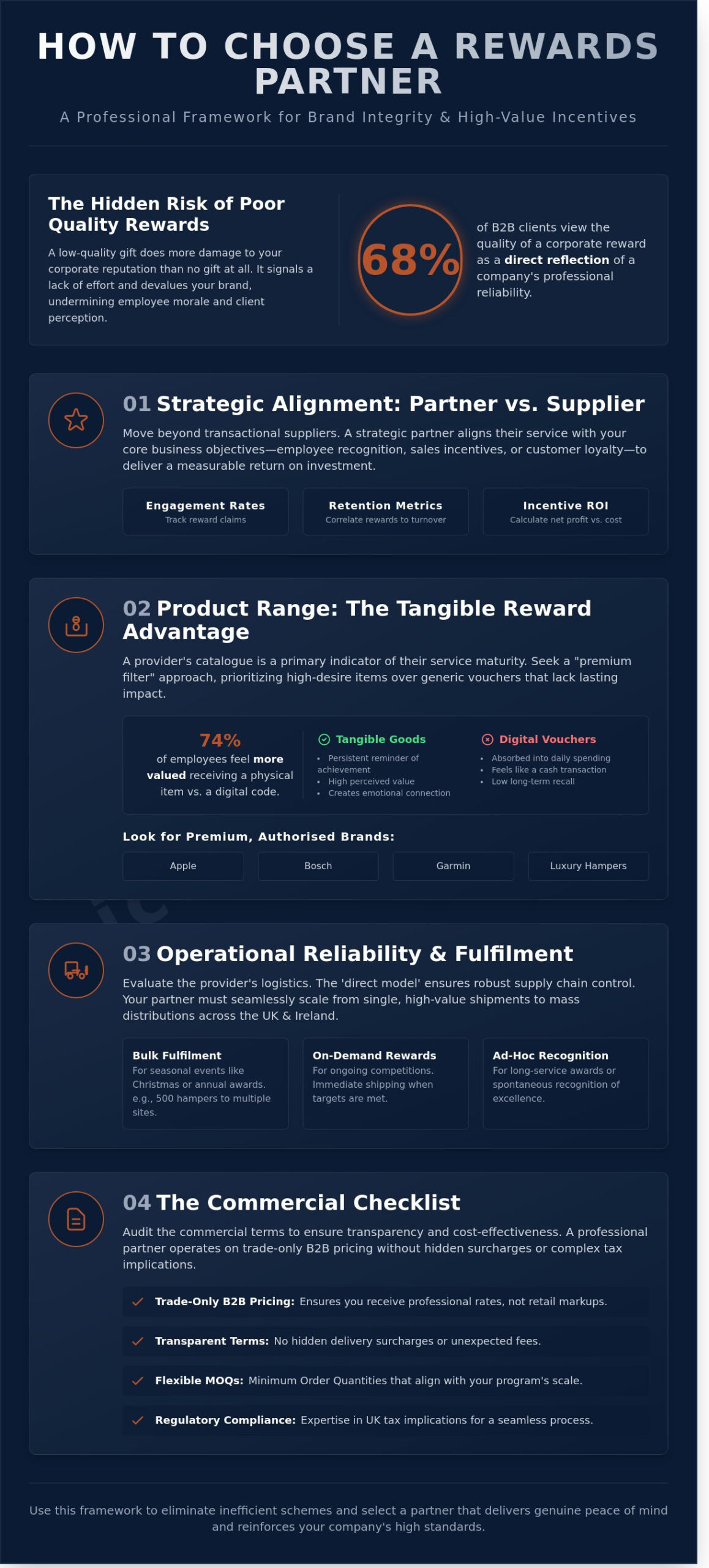
A low-quality plastic power bank that fails after three uses does more damage to your corporate reputation than sending no gift at all. Research indicates that 68% of B2B clients view the quality of a reward as a direct reflection of a company’s professional reliability. Understanding how to choose a rewards provider is therefore a vital safeguard for your brand’s integrity. You already know that an incentive programme should mirror the high standards of your own services. However, the reality often involves hidden delivery surcharges and complex tax implications that turn a simple gesture into a logistical burden.
This guide offers a professional framework to vet partners based on inventory quality and trade-only expertise. We provide a strategic checklist to help you secure premium brands like Apple and ensure a seamless fulfilment process that complies with UK regulations. You will learn how to eliminate inefficient schemes and replace them with a robust, high-value solution that delivers genuine peace of mind.
Key Takeaways
- Distinguish between transactional gift suppliers and strategic partners to ensure your recognition programmes align with core business objectives.
- Learn how to choose a rewards provider by evaluating their catalogue against a ‘premium filter’ that prioritises tangible value over generic vouchers.
- Evaluate the logistical reliability of the ‘direct model’ to ensure seamless fulfilment and robust supply chain control across the UK and Ireland.
- Audit commercial terms and Minimum Order Quantities (MOQs) to maintain cost-effectiveness while securing professional trade-only B2B pricing.
- Implement a 10-point selection framework to verify brand authorisations and ensure your partner meets the highest standards of operational accountability.
Defining Your Strategic Objectives for a Rewards Partnership
Identifying the primary driver for a rewards programme is the first step in understanding how to choose a rewards provider that delivers measurable value. Your core purpose usually falls into three categories: Employee recognition, sales incentives, or customer loyalty. Each requires a different operational approach. A gift supplier simply manages stock and shipping. A strategic rewards partner, however, aligns their service with your business goals to ensure the investment produces a tangible return.
Data from 2023 indicates that tangible goods outperform digital vouchers in long-term recall. While a £50 voucher is often absorbed into monthly grocery spending, a physical item serves as a persistent reminder of achievement. You must establish clear KPIs before signing a contract. Aim for specific targets, such as a 15% increase in sales activity during a quarterly competition or a 12% improvement in staff retention scores. These metrics allow you to evaluate the partnership with clinical precision.
- Engagement rates: Track how many eligible participants actually claim their rewards.
- Retention metrics: Measure the correlation between reward frequency and staff turnover.
- Incentive ROI: Calculate the net profit generated by sales incentives against the cost of the rewards.
Aligning Rewards with Corporate Values
Premium brands like Apple reinforce a high-performance culture by ensuring their internal rewards match their external market positioning. Providing high-quality hardware signals that the organisation values excellence. Conversely, generic promotional items like plastic mugs or cheap keyrings can devalue your brand. They suggest a lack of effort and fail to improve morale. A strategic partner helps you select items that reflect your professional standing and duty of care to your workforce.
Determining Your Fulfilment Frequency
Operational efficiency depends on matching the provider’s logistics to your specific schedule. You might require bulk fulfilment for seasonal events, such as 500 Christmas hampers delivered to multiple UK sites by 15 December. Alternatively, ongoing sales competitions require on-demand rewards that ship immediately upon a lead closing. Long-service awards and ad-hoc recognition require a partner capable of handling individual, high-value shipments without delay. Understanding how to choose a rewards provider involves auditing their ability to scale from single deliveries to mass distribution seamlessly.
Evaluating Product Range: The Tangible Reward Advantage
When deciding how to choose a rewards provider, the physical catalogue serves as a primary indicator of the service’s maturity. A professional provider applies a “premium filter” to their inventory, ensuring every item carries a high perceived value. This approach avoids the common pitfall of voucher-based systems. Vouchers often feel like a simple cash transaction, whereas a physical product like a high-end coffee machine or a premium tablet feels like a genuine gift. A 2023 industry report found that 74% of employees felt more valued when receiving a physical item compared to a digital code of the same monetary worth.
Broad category depth is essential for a successful programme. A limited selection leads to recipient fatigue. Your provider should offer everything from Apple electronics to high-end garden furniture. Customisation also plays a role. A bespoke hamper tailored to a specific achievement carries more weight than an off-the-shelf product. This level of detail shows the recipient that their effort was recognised with precision, which is a key factor when considering how to choose a rewards provider for a long-term partnership.
The Power of Premium Brands
High-desire incentives like Apple AirPods, currently retailing around £129, or the latest iPad models starting at £369, create immediate engagement. These are aspirational items people rarely buy for themselves. Luxury food and drink hampers should feature recognisable, high-quality brands rather than generic fillers. While academic studies on Intrinsic Rewards and Employee’s Performance emphasise the psychological side of motivation, the tangible reward acts as the physical anchor for that motivation. Lifestyle rewards like Bosch garden tools or Garmin gym gear ensure the reward remains useful in the recipient’s daily life.
Avoiding the ‘Promo Item’ Trap
Professional organisations must avoid “promo” items like branded pens or cheap polyester clothing. These items often end up in landfills, which can damage your brand’s reputation for quality. In B2B gifting, a 2024 survey revealed that 82% of recipients believe the quality of a gift directly reflects the value of the business relationship. High-end tech and professional golf equipment, such as Titleist sets, are far more effective for corporate incentives. To ensure your rewards meet these standards, you can view our professional reward solutions which focus on quality over quantity. Every item should be durable and serve a clear purpose in a professional or domestic setting.
Assessing Operational Reliability and Fulfilment Capability
Efficiency in this sector isn’t just about software; it’s about physical assets. This operational rigour aligns with the strategic shifts discussed in Total Rewards Reimagined, where execution is as vital as the reward itself. A provider’s ability to manage 10,000+ SKUs across multiple territories determines the long-term viability of your programme.
Logistical Footprint: Halstead and Cork Centres
Strategic distribution centres in Halstead, Essex, and County Cork, Ireland, are essential for seamless cross-border delivery. These dedicated hubs allow for 24 to 48-hour fulfilment cycles across the UK and Ireland. By maintaining a local presence in both markets, a provider can bypass the customs delays and additional VAT complexities that often plague smaller operations. This infrastructure is particularly critical for bulk orders, ensuring that 500 units reach their destination with the same speed and clinical efficiency as a single parcel.
Storage and Prize Fulfilment Services
Prize fulfilment is a comprehensive end-to-end logistics service for corporate incentives. Outsourcing this headache allows your internal teams to focus on strategy rather than packing boxes or chasing couriers. A professional provider offers real-time tracking and granular reporting, giving you 100% visibility over your reward spend. This level of transparency is vital for statutory compliance and internal budget management. When you assess how to choose a rewards provider, ensure they offer a methodical, systematic approach to storage, pick-and-pack services, and final-mile distribution.
The Commercial Checklist: Transparency, MOQ, and Trade Terms
Commercial viability hinges on transparency and the elimination of unnecessary middlemen. Trade-only providers offer a direct service model that removes the 15% mark-up standard in retail-based procurement. When you evaluate how to choose a rewards provider, prioritize those who offer net trade pricing rather than simple RRP discounts. This approach ensures your budget is spent on the reward itself, not on intermediary margins.
Hidden costs represent a significant risk to project budgets. Generic logistical fees or unquoted delivery surcharges often add £5 to £12 per unit to the final invoice. A professional partner provides a comprehensive breakdown of all costs from the outset. This financial clarity allows for accurate forecasting and prevents end-of-quarter budget deficits. Reliability in pricing is as vital as the quality of the products supplied.
A dedicated account manager is a necessity for professional operations. Companies that rely on generic helpdesk ticketing systems see a 35% increase in lead times for resolving delivery discrepancies. You need a specialist who understands your specific trade terms and can handle complex requirements with clinical efficiency. Personal accountability ensures that your recognition programme remains on track without administrative friction.
Flexibility and No-MOQ Advantages
Strict Minimum Order Quantities (MOQs) restrict your ability to react to performance milestones in real-time. Traditional suppliers often require orders of 50 units or more to trigger trade pricing. A no-MOQ policy allows you to reward a single employee or a 200-person department with the same level of cost-efficiency. This agility is essential for managing budget fluctuations. It ensures that recognition is never delayed by the need to “bulk up” an order to meet arbitrary supplier thresholds.
Compliance and Duty of Care
Your provider must operate strictly within the framework of UK law. This includes adherence to the Health and Safety at Work Act 1974 and specific product standards like BS 7671 for electrical items. Professional trade partners manage product warranties and returns as part of their statutory duty of care. This protects your organisation from liability and ensures every item delivered meets rigorous safety benchmarks. Understanding how to choose a rewards provider involves auditing their compliance history to ensure they meet these high-stakes regulatory burdens.
Protect your business and streamline your procurement by partnering with a specialist who understands UK trade regulations.
Making the Final Decision: A 10-Point Selection Framework
The final stage of the selection process focuses on operational due diligence. Understanding how to choose a rewards provider requires looking beyond the digital storefront and examining the infrastructure behind the fulfilment. A provider’s trade-only status is the first point of verification. This ensures you access genuine B2B pricing, often 15% lower than retail rates, which protects your budget and maintains the perceived value of the reward.
Audit the brand portfolio with a focus on authorised supply chains. Premium electronics, such as high-end audio equipment or tablets, must come from authorised distributors to guarantee valid UK warranties. You should also review their ‘not sold’ list. A reputable partner avoids brand-diluting generic items. If a catalogue is cluttered with low-quality promotional plastic, it undermines the prestige of your corporate incentive.
Logistics remains the ultimate test of a provider’s capability. Verify they have local distribution centres. For UK-based firms, this means ensuring they have established routes to manage the 20% VAT and customs requirements for distribution into Ireland and the wider EU.
Final Vetting Questions for Procurement
- Bespoke Branding: Can they provide precision laser engraving or custom packaging on high-value items like premium power banks?
- Peak Performance: What was their on-time delivery rate during the previous Q4? Look for a track record of 99.7% or higher during peak fulfilment seasons.
- Cross-Border Logistics: Do they possess a valid EORI number and a proven system for handling international distribution between the UK and EU (Ireland) without delivery delays?
The ROI of Premium Partnership
Calculating the return on investment involves more than just the unit cost of a reward. Managing a rewards programme internally can cost a business up to £45 per claim in administrative time and logistical troubleshooting. Outsourcing to a specialist reduces this overhead to zero. With 30 years of industry expertise, a partner provides a critical trust signal that ensures your brand reputation is protected during every delivery. This longevity proves they can manage complex supply chains and regulatory shifts with clinical efficiency.
Securing a High-Performance Rewards Partnership
Selecting the right partner is a critical commercial decision that impacts your brand reputation and operational efficiency. You must prioritise providers that offer direct supply chain control and a rigorous selection framework to mitigate risk. Understanding how to choose a rewards provider requires assessing both the breadth of the premium product range and the absolute reliability of the fulfilment infrastructure. It’s essential to focus on partners who eliminate intermediaries to ensure cost-effective delivery and consistent stock availability.
EiC Direct brings 30+ years of specialist B2B experience to your incentive strategy. We maintain total control through our dedicated distribution centres in Halstead and Cork, providing a streamlined path from the manufacturer to your recipient. As an authorised supplier of Apple and leading luxury lifestyle brands, we guarantee product authenticity and premium quality. Our transparent trade terms and established logistics network provide the peace of mind required for complex corporate schemes. Partner with EiC Direct for Premium Trade-Only Rewards to build a scalable, compliant, and highly effective incentive programme today.
Frequently Asked Questions
What is the difference between a rewards provider and a promotional gift company?
A rewards provider manages high-value incentive strategy and end-to-end fulfilment, while promotional gift companies focus on mass-produced, low-cost merchandise for brand visibility. Professional providers offer a curated selection of premium goods that drive specific performance behaviours. They handle the complex logistics of individual doorstep delivery, which 85% of promotional companies aren’t equipped to manage. This service model ensures a seamless experience for the recipient.
Why should our business choose physical rewards over gift vouchers?
Physical rewards provide a 15% higher retention of trophy value compared to digital vouchers that often disappear into daily living expenses. When you evaluate how to choose a rewards provider, consider that tangible items create a lasting emotional connection to the achievement. A 2023 study showed that employees recall a physical gift 3 times longer than a cash equivalent. It’s a more effective way to drive long-term loyalty.
Can we get custom branding on premium Apple products or luxury hampers?
Custom branding is available for premium items through precision laser engraving and bespoke packaging solutions. We provide high-resolution logo placement on Apple hardware that maintains the 12-month manufacturer warranty. For luxury hampers, we use 25mm satin ribbons and embossed gift cards to ensure your corporate identity is presented with absolute technical precision. This maintains your brand’s professional image without compromising the product’s quality.
How much does a professional prize fulfilment service cost?
Professional prize fulfilment services typically cost between £6.50 and £18.50 per shipment. This fee covers the secure storage, professional packing, and tracked courier delivery within the UK mainland. Large-scale campaigns often benefit from a 10% reduction in unit costs when volumes exceed 500 individual despatches per month. We provide a transparent breakdown of these costs during the initial consultation to ensure your budget is managed efficiently.
Is there a minimum order quantity for corporate rewards?
The standard minimum order quantity for corporate rewards is 25 units or a minimum spend of £1,500 per campaign. This threshold ensures the logistical setup and account management remain commercially viable for both parties. Smaller batches can be accommodated under specific service level agreements, though unit costs may increase by 12% to cover administrative overheads. We’ll help you determine the most cost-effective volume for your specific programme requirements.
How do you manage reward distribution for employees in both the UK and Ireland?
We manage UK and Ireland distribution through a dual-territory logistics framework to bypass post-Brexit customs delays. By utilising a dedicated hub in Dublin for Irish deliveries, we eliminate the 23% VAT import complications and standardise delivery times to 48 hours. This methodical approach ensures your compliance with local trade regulations remains intact. It’s a reliable solution that prevents unexpected costs or delays for your staff.
What are the most popular tech rewards for sales incentives in 2026?
In 2026, the most popular tech rewards will include AI-enhanced biometric wearables and 8K portable projectors for hybrid working environments. Market data suggests that 38% of top-performing sales staff prefer high-spec noise-cancelling equipment over traditional gift cards. We expect a 22% increase in demand for sustainable, solar-powered personal electronics throughout the 2026 fiscal year. Choosing these high-demand items ensures your incentive programme remains relevant and motivating.
How do I ensure our reward programme is tax-efficient for employees?
To ensure tax efficiency, you should utilise the HMRC Trivial Benefit allowance for rewards valued at £50 or less. For higher-value incentives, we recommend a Taxed Award Scheme where the employer pays the tax and National Insurance on the employee’s behalf. This prevents the reward from becoming a financial burden, maintaining high morale across your workforce. Our team provides the necessary reporting data to make this process straightforward for your payroll department, while specialists like ICSPayroll can provide similar expertise for companies needing EOR and payroll support for employees in the Netherlands.